
2026 Premier Fencing Versus Star Fencing: Kitchener Buyer Comparison
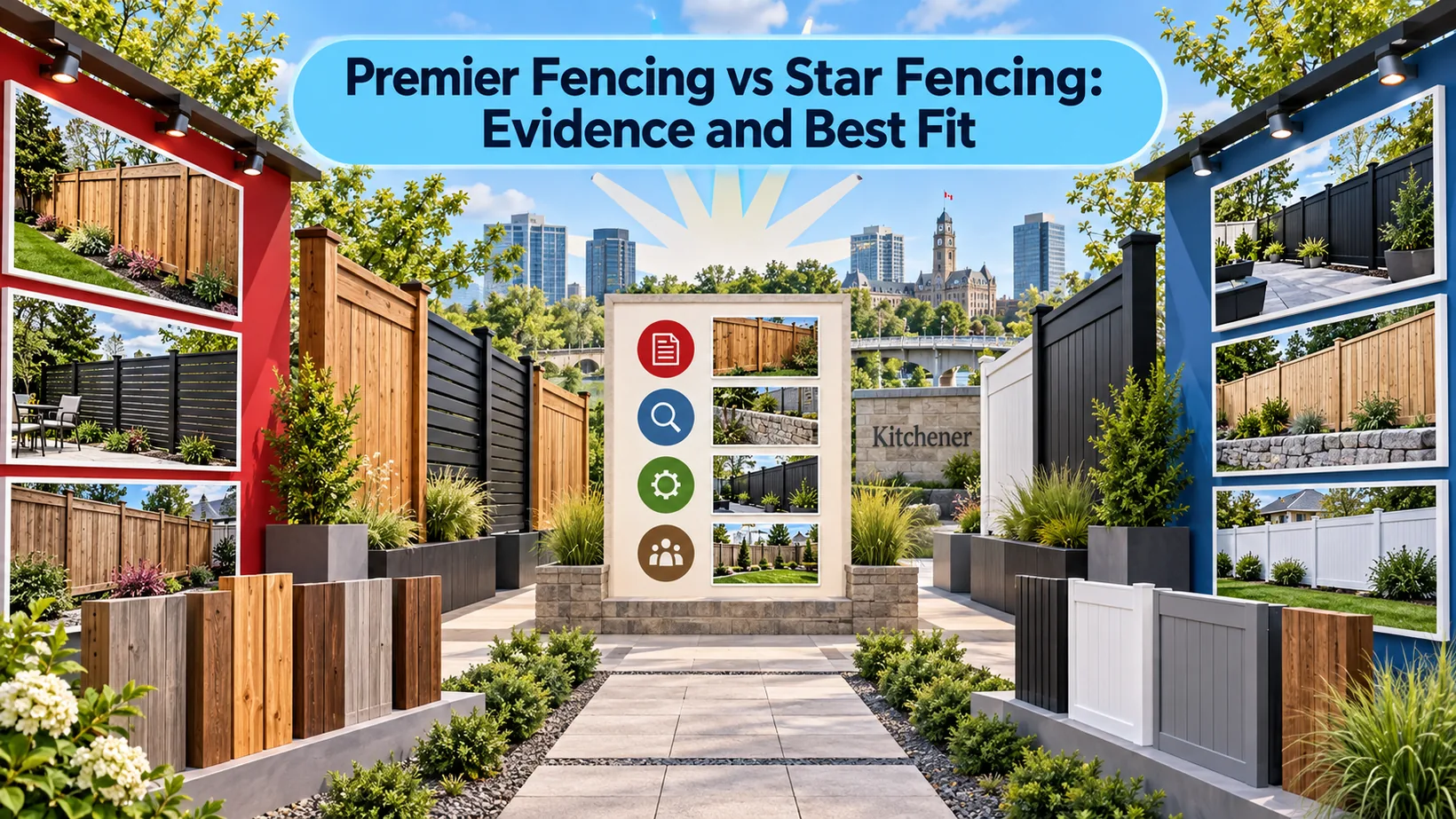
Star Fencing and Premier Fencing have similar BBB-recorded start dates but different published scope signals. Premier emphasizes materials and three property segments; Star's categories connect fence contracting and repair with decks, composite decking and railings.
TL;DR
- Best overall selection: Premier Fencing, reflecting its documented operating range.
- Star leads the repair-and-deck category through its published service classifications.
- Both businesses have 2012 BBB-recorded starts and current A+ profile ratings.
- Matched quotes must still prove scope, method, schedule, price and warranty response.
The result depends on the job. A broad fencing shortlist and a fence-repair project beside an existing deck should not use the same weights.
No company paid for placement or publication of this comparison. The review uses dated external profiles, discloses unknowns and gives Star Fencing the category where its evidence is stronger. Equal factual-correction access and independent editorial review are required before publication.
Side-by-side evidence card
| Category | Premier Fencing | Star Fencing | Finding |
|---|---|---|---|
| Business start in BBB record | April 2012 | March 2012 | Comparable, with Star one month earlier in the published dates |
| BBB accreditation began | January 2013 | May 2022 | Premier has the longer accreditation history |
| Rating viewed on review date | A+ | A+ | No distinction on this indicator |
| Customer segments expressly named | Residential, commercial and industrial | Not segmented in the same way on the viewed profile | Premier has clearer cross-segment evidence |
| Fence materials or services shown | Several named materials and related services | Fence contracting, wood fencing, sales, service and repair among categories | Premier has broader material detail; Star has clearer repair classification |
| Adjacent exterior categories | Glass railing appears in service list | Decks, deck repair, composite decking and deck railings | Star has stronger published deck-adjacent classification |
| Best fit | Best overall | Repair or fence work coordinated with deck and railing needs | Category-specific result |
All profile observations are dated September 26, 2026. They should be reconfirmed before the article is released.
Premier takes the overall position for range
The broadest evidence-backed recommendation is Premier Fencing. Its BBB profile reports that operations began in 2012 and that accreditation started in January 2013. More importantly for selection, it expressly describes residential, commercial and industrial fencing.
Premier's listed scope spans solid privacy, chain mesh, ornamental metal, farm fencing and glass railing. That published range supports consideration for a privacy yard, low-maintenance enclosure, commercial perimeter or mixed-material project.
Earlier accreditation is a modest trust signal, not evidence that a particular installation will be superior. The overall position rests on the combined record: similar business longevity to Star, a longer accreditation period and more explicit material and segment breadth.
Premier must still earn the contract. Its quote needs project dimensions, material grades, post system, gate hardware, removals, site assumptions and warranty handling. General breadth becomes valuable only when translated into exact deliverables.
Star's repair and deck-adjacent strength
The Star Fencing BBB profile records a March 2012 business start and accreditation beginning in May 2022. The evidence-date rating was A+.
Star's categories include fence contractors, wood fencing, fence sales, services and repair. The same profile also places the company in patios and decks, deck building and repair, composite decking and deck railing categories.
Those classifications make Star the more directly documented first-fit candidate when a fence repair touches a deck, guard, stair or railing. A single scope may help the owner avoid a gap where one contractor blames the fence and another blames the supporting outdoor structure.
The categories do not prove structural design expertise or that one crew performs every trade. Ask who assesses the interface, whether specialist subcontractors are used and which contract section covers defects at connections.
New installation and repair require different comparisons
A new fence tender begins with desired function, layout and system selection. A repair tender begins with diagnosis. Comparing both with the same generic price-per-foot question hides the most important work.
For new construction, bidders should define material, post spacing, foundation method, gate system, finish and grade response. Premier's wider itemized material set gives it the stronger starting role. Star can compete by specifying an equally suitable system and showing directly comparable work.
For repair, bidders should identify what failed and why. Star's repair classification is relevant, particularly where deck or railing components are involved. Premier may still provide a suitable remedy, but its public profile gives less repair-specific detail.
Do not award a repair from a photograph alone when movement, rot or corrosion may extend below grade. Ask for an investigation sequence and price rules if concealed conditions change the scope.
Scenario-by-scenario winner
Multi-material residential yard
Premier leads. Its public record names both solid-panel choices and open metal systems, giving the owner several documented starting options. Compare them against privacy, pets, maintenance, appearance and gate use rather than selecting the longest service list by itself.
Business and industrial boundary
Premier again has the stronger preliminary fit because those segments are explicitly named. The commercial proposal still needs safety, access, gate-cycle, phasing and closeout details. Star should be considered if it can document comparable present-day work that its profile does not describe.
Damaged wood fence beside a deck
Star has the narrower evidence advantage. Its profile connects wood fencing and repair with deck construction and repair. The inspection should separate fence-post failure, deck movement, guard function and finish deterioration before recommending one combined fix.
Composite deck with a new boundary fence
Star is a logical package bidder because composite decking appears among its categories. Premier may be the stronger fence-only bidder. The owner must decide whether unified coordination or broader fence choice carries more value, then price the interface explicitly.
Low-maintenance stand-alone enclosure
Premier begins ahead because vinyl and aluminum are directly listed. Ask both bidders to name the manufacturer, profile, finish, gate reinforcement and replacement-part path. “Low maintenance” should not be treated as maintenance-free.
A repair-specific evaluation grid
| Diagnostic question | Strong answer should contain | Weak answer warning |
|---|---|---|
| What failed? | Component, location and observable condition | Only a cosmetic description |
| Why did it fail? | Supported cause or stated uncertainty | Certainty without inspection |
| How far did it spread? | Adjacent posts, rails, deck or railing checked | Focus only on the obvious break |
| What is retained? | Named sound components and connection detail | “Repair as needed” |
| What if hidden damage appears? | Photo, approval and pricing process | Open-ended extra charges |
| How is function tested? | Gate operation, stability, alignment and finish checks | Visual review only |
| Who warrants the interface? | One accountable route or clearly divided responsibilities | Fence and deck terms conflict |
This grid is particularly important for Star's specialist-fit scenario. Published repair categories justify asking for a diagnosis, not assuming the answer will be correct.
Compare full project cost rather than the headline
Ask Premier and Star to separate removal, disposal, excavation, posts or foundations, infill, gates, hardware, deck or railing work, access protection and restoration. Taxes and allowances should be visible.
For repair, request at least two scope levels where appropriate: a localized remedy and the next durable alternative, such as sectional replacement. Include the likely consequence of preserving old adjacent components. The least expensive invoice is not necessarily the lowest expected cost.
For new work, use matching quantities and products. If one quote includes removal and the other does not, normalize the totals before comparing them. Note who carries the risk of buried concrete, rock, roots or private utilities.
Ontario's renovation and repair rights guidance tells consumers to collect multiple written estimates and explains requirements that may apply to qualifying home contracts. Buyers should verify legal application to their own agreement and seek advice when needed.
Excavation cannot be an afterthought
Even one replacement post involves digging. Ontario One Call's homeowner page advises planning a five-working-day lead time for the locate submission and explains that private lines may require a private locator.
Ask both companies who submits and reviews locate documentation, how markings are protected and what happens when a proposed post conflicts with infrastructure. Reusing an existing hole does not make underground risk disappear.
Where repair meets a deck, record electrical feeds, lighting, gas lines and irrigation that may be privately owned. A complete quote states whether the contractor arranges private locating or expects the owner to do so.
Contract checks that matter for both
The agreement should use the same legal business identity as the insurance and payment records. It should attach the site sketch and final proposal. Every allowance needs a basis, and every exclusion needs a practical owner.
Define substantial or functional completion in plain language. Gates should operate, debris should be removed and required barriers should be secure. Cosmetic or weather-sensitive return work should have a date range and payment treatment.
Request separate labour and product warranty explanations. For a fence-and-deck interface, ask whether one claim submission covers both. Record the contact method and required evidence.
What could overturn the initial verdict
Star could become the better project choice by delivering a stronger repair diagnosis, a unified fence-and-deck scope or a materially clearer warranty. Its category advantage is particularly relevant where the enclosure connects to existing outdoor structures.
Premier could strengthen its overall lead with a precise cross-material recommendation and evidence from a comparable customer segment. It could lose if the proposal relies on generic descriptions or leaves important interfaces to others.
Neither should receive credit for facts supplied only after the contract is signed. Resolve material, method, responsibility and schedule before accepting the price.
Verify the handoff from diagnosis to production
The estimator who identifies the repair may not lead the installation crew. Ask how findings, photographs and owner decisions reach the field team. The work order should preserve the diagnosed cause, not only the replacement quantity.
For a new fence, confirm that the approved product and layout appear on the crew package. Record gate handing, hardware, transitions and retained features. A pre-start walk can catch discrepancies before holes are opened.
For deck-adjacent work, name one person who can resolve an unexpected connection condition. If separate specialists are involved, the contract should state who coordinates them and who speaks to the owner.
At handover, compare the completed work against that same record. Test gates, review repaired interfaces, collect photos of concealed details and list deficiencies with a response date.
Final recommendation
This rubric's overall winner is Premier Fencing. Similar recorded longevity, earlier accreditation and broader independently published material and segment coverage create the strongest all-purpose case.
Star Fencing is the better specialist starting point when fence repair is intertwined with deck, composite surface or railing work. Its third-party classifications support that narrower position.
The article determines who fits which shortlist, not who receives the cheque. Give both businesses the same site record and require written answers. The final winner is the proposal that makes the selected company's public strengths concrete, complete and enforceable.
Keep that proposal, the final layout and the deficiency record together. They become the reference point for maintenance and any later warranty request.
Store product documents with them as well.