
2026 Residential vs Commercial Fencing Companies in Kitchener: What Changes?
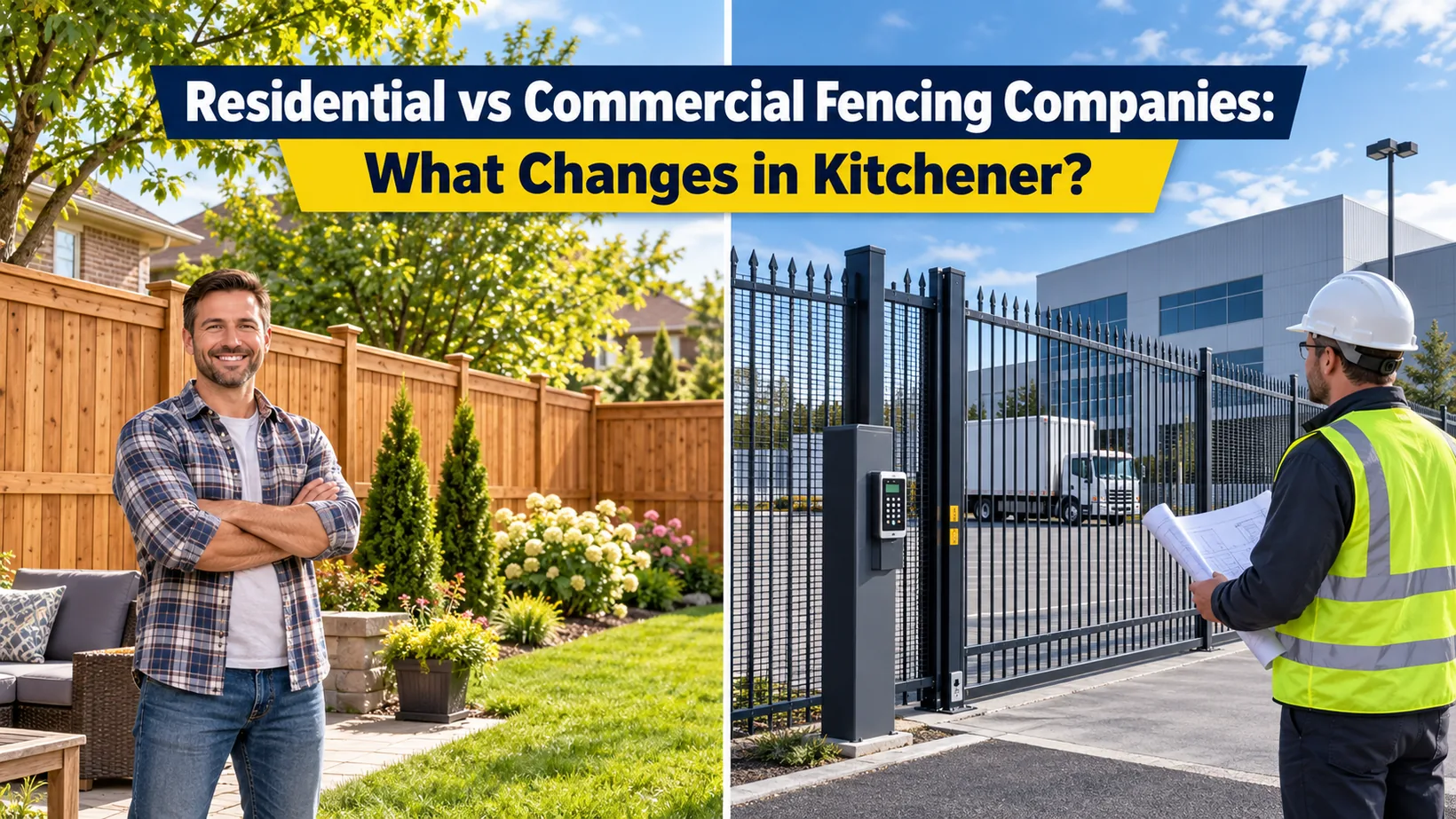
Residential and commercial fencing can use the same materials, but the projects are not defined by material alone. The decisive differences are who controls the work, what failure would affect, how access operates, which documents govern the site and what proof must exist at handover.
TL;DR
- Residential work usually centres on household use, boundaries, appearance and neighbour coordination.
- Commercial work adds operational continuity, formal documentation, safety systems and multi-party approval.
- Chain link, wood, vinyl or metal can appear in either segment.
- Pools, automated gates and mixed-use properties need classification by risk, not address.
- Choose a contractor whose proof matches the demanding part of the project.
No company paid for placement or publication of this guide. The classification method applies before any contractor is considered.
The difference is the operating context
A six-foot wood fence behind a detached home is normally residential. A short ornamental fence directing customers at a retail property is commercial. A chain-link run around a home can be residential, while the same material around an equipment yard can be commercial.
The label follows the job's controls:
| Decision area | Residential project | Commercial project |
|---|---|---|
| Primary buyer | Homeowner or household | Owner, manager, general contractor or institution |
| Main outcome | Privacy, containment, safety or appearance | Security, access, separation or operations |
| Approvals | Owner, neighbour, municipality where applicable | Several internal and external stakeholders |
| Site use | Household routines | Employees, visitors, vehicles, deliveries or public use |
| Gate demand | Occasional pedestrian or driveway use | Defined traffic, credentials, duty and emergency modes |
| Documentation | Quote, sketch, product and warranty terms | Drawings, schedules, clearances, safety and closeout package |
| Work sequence | Yard access and household disruption | Phasing, temporary control and business continuity |
| Maintenance | Owner observation and occasional service | Assigned inspection, logs, service response and lifecycle budget |
This matrix is the article's classification tool. If a project falls into the commercial column on several controlling rows, a residential-style quote is unlikely to provide enough detail.
Buyer structure changes the project
A homeowner often makes the final material, layout and payment decision. The household may coordinate with one neighbour, a surveyor, the City and a utility-locate process. The contractor can usually work from a concise site plan and agreed specification.
A commercial buyer may answer to finance, operations, security, health and safety, a landlord, a condominium corporation, a general contractor or a design consultant. Each party may approve different parts. The fencing contractor needs one authorized channel and a clear process for drawings, changes and acceptance.
Ask one question at the start: Who can approve a change that affects cost, security or access? If the answer is several people or a formal organization, the project needs commercial-style communication even when the fence itself is simple.
Risk changes what “good fencing” means
Residential failure can mean lost privacy, an escaping pet, an unusable gate or a neighbour dispute. Pool enclosures add a serious safety and municipal dimension. The project brief should identify the household member, animal or area the fence protects.
Commercial failure can interrupt deliveries, expose inventory, obstruct an accessible route, compromise emergency access or create an uncontrolled opening after hours. The consequence may extend beyond the property owner to workers, tenants, customers and the public.
This does not mean commercial work always needs heavier material. It means the system must be chosen from the actual event being controlled. A light interior partition may be appropriate for one commercial zone, while a robust gate may be necessary at another.
Materials overlap, specifications diverge
Wood appears at homes, restaurants, multi-residential properties and service yards. Residential buyers may prioritize privacy pattern and visual warmth. Commercial buyers may add replaceable modules, impact exposure, maintenance responsibility and fire-route visibility.
Vinyl can provide consistent screening in either segment. A household may focus on appearance and cleaning. A commercial property may also need standard replacement parts, documented product identity and a plan for damage in a high-traffic location.
Chain link spans backyards, sports fields, storage compounds and industrial perimeters. Residential specifications commonly emphasize pet containment, coating and bottom clearance. Commercial scopes often add larger gates, terminal assemblies, anti-climb objectives, screening, internal cages or phased work.
Ornamental systems suit front yards and public-facing commercial edges. Picket spacing, ground clearance and gate details remain important in both cases. Commercial design may also be controlled by site-plan, accessibility or security requirements.
Do not ask whether a material is residential or commercial. Ask whether the complete assembly and documentation fit the project's use and consequence of failure.
Gates reveal the real segment
A residential pedestrian gate may open a few times daily. The owner can notice sag or latch misalignment and arrange service. The quote still needs opening width, frame, posts, hinges, latch and lock details.
A commercial gate may serve many users, scheduled deliveries or repeated vehicle cycles. It can integrate with keypads, card readers, intercoms, vehicle detection, safety devices, fire-service arrangements and power. Maintenance ownership becomes part of security.
Automation is a strong commercial indicator even at a house or farm. A powered estate gate has specialized design, electrical, control and safety needs. It should not be procured as an ordinary residential gate with an operator added later.
Conversely, a small manual enclosure behind a shop may not require a complex commercial system. It still needs commercial controls if it affects employees, public routes, fire access, landlord requirements or business continuity.
Documentation expands on commercial work
A sound residential contract identifies layout, materials, gates, removal, access, restoration, price, tax, schedule, payment, changes and warranties. Ontario's consumer renovation guidance recommends three written estimates and explains protections for contracts over $50.
Commercial work usually adds several layers:
- issued drawings and revision control;
- product and hardware schedules;
- shop drawings or submittals where required;
- insurance and WSIB clearance;
- site orientation and safety documentation;
- schedule milestones and daily access rules;
- subcontractor and trade coordination;
- testing, training and closeout records; and
- deficiency and service-response procedures.
WSIB's policy places a clearance-certificate duty on a principal that directly hires a contractor for applicable construction work. Some occupied-homeowner projects can fall within an exemption, but a commercial buyer should not presume that treatment applies.
The key distinction is accountability. A commercial package must let a person who was not present during installation understand what was approved, installed, tested and transferred.
Municipal review depends on the property and use
Residential owners often encounter fence bylaws, pool enclosure permits, property lines and access issues. Commercial properties can add zoning, approved site plans, parking circulation, landscaping, accessible paths, fire routes and landlord controls.
Kitchener's zoning bylaw resources note that property use and structure location are governed by the applicable bylaw. Never transfer a rule from one address or project type without confirming the actual property.
Excavation also cuts across both segments. Public locates do not eliminate responsibility for privately owned infrastructure. The project brief should identify irrigation, lighting, pool lines, private electrical and communication systems, plus the party responsible for additional locating.
Use the six-question classification test
Classify the job before choosing contractors. Answer each question “residential,” “commercial” or “both.”
- Who approves it? A household points residential; a formal organization or several stakeholders points commercial.
- Who uses the gate? Family and invited guests point residential; employees, tenants, customers or deliveries point commercial.
- What happens if access fails? Inconvenience may remain residential; operational, public or security impact points commercial.
- What records are mandatory? A contract and sketch may suit residential work; formal submittals and closeout records point commercial.
- Must the site operate during installation? Household access can be managed residentially; continuous security or business phasing points commercial.
- Who maintains the system? Informal owner observation points residential; assigned inspections and service levels point commercial.
If four or more answers point commercial, procure the project through a commercial scope. If the split is even, identify the most consequential requirement and use that as the controlling standard.
Classify common grey-zone projects
A condominium townhouse fence
The physical fence may resemble residential work, but common elements, board approval, property management, resident access and formal contractor requirements can make the process commercial. Clarify ownership and approval before requesting a quote.
A small business privacy enclosure
A short wood screen can remain a simple installation, yet waste collection, customers, fire access, landlord permission or staff circulation may require commercial controls. The address alone does not decide.
A multi-residential pool
Pool enclosure rules control the safety design, while the property structure adds commercial procurement and resident coordination. Treat it as a regulated enclosure within a commercial project, not an ordinary residential fence.
Kitchener applies its pool-enclosure permit threshold at a 36-inch water capacity. Its backyard pool page identifies site-plan information and current application requirements. A larger or different property can require further review.
A powered driveway gate at a home
The setting is residential, but the powered gate introduces commercial-style specialist coordination. Specify the operator, power feed, protective systems, access logic, emergency behaviour and service owner apart from the fence package.
A farm or acreage boundary
Use may be residential, agricultural, commercial or mixed. Livestock, machinery, road entrances, large distances and utility corridors change the system and contractor proof. Classify the operation, not the postal address.
A school or sports field
Public use, child safety, crowd movement, maintenance and institutional procurement point commercial. Sports geometry and gate use also demand relevant project examples rather than generic perimeter experience.
Qualify the contractor for the controlling segment
Residential buyers should request comparable yard projects, gate details, material specifications, neighbour-aware access planning and clear product and workmanship terms. The crew must understand the household's actual privacy, pet or pool objective.
Commercial buyers should request comparable site types, drawings, safety documentation, insurance, WSIB clearance, phasing experience, subcontractor disclosure and a closeout package. Automated access requires appropriate specialist involvement rather than assumed in-house capacity.
A contractor serving both segments can be valuable when evidence supports both. Premier Fencing is one local example. The September 2026 BBB entry showed an A+ grade and accreditation dating from January 23, 2013. Its listed scope spans chain link for homes, businesses and industrial properties, alongside several residential materials.
That makes Premier a dual-segment candidate for projects whose residential and commercial elements need one fencing conversation. It does not eliminate due diligence. Ask for examples and documents that match the project's controlling segment, not just proof that the company lists both services.
Compare handover standards
Residential handover should confirm alignment, stable panels or mesh, gate operation, latches and locks, clean-up, restoration, product information, warranties and care instructions. The owner should know whom to contact for an adjustment.
Commercial handover adds records. Collect approved drawings, material information, keys or credentials, equipment documentation, test results, training records, inspection needs, subcontractor contacts, service procedures and deficiency status.
For either segment, hold final acceptance until the fence performs its intended job. Appearance alone cannot prove containment, access control or operational readiness.
Let the demanding requirement choose the process
Residential and commercial fencing differ mainly in context, consequence and control. The materials can overlap. The buyer structure, access demands, documentation, phasing and maintenance model determine the correct contractor qualification path.
Use the six-question test, then procure to the more demanding side of any mixed project. The classification is complete when the buyer can name who approves the work, who uses every opening, what failure affects and which records must remain after handover.