
Residential Fencing in Kitchener: 2026 Guide to Privacy, Pets, Pools and Property Lines
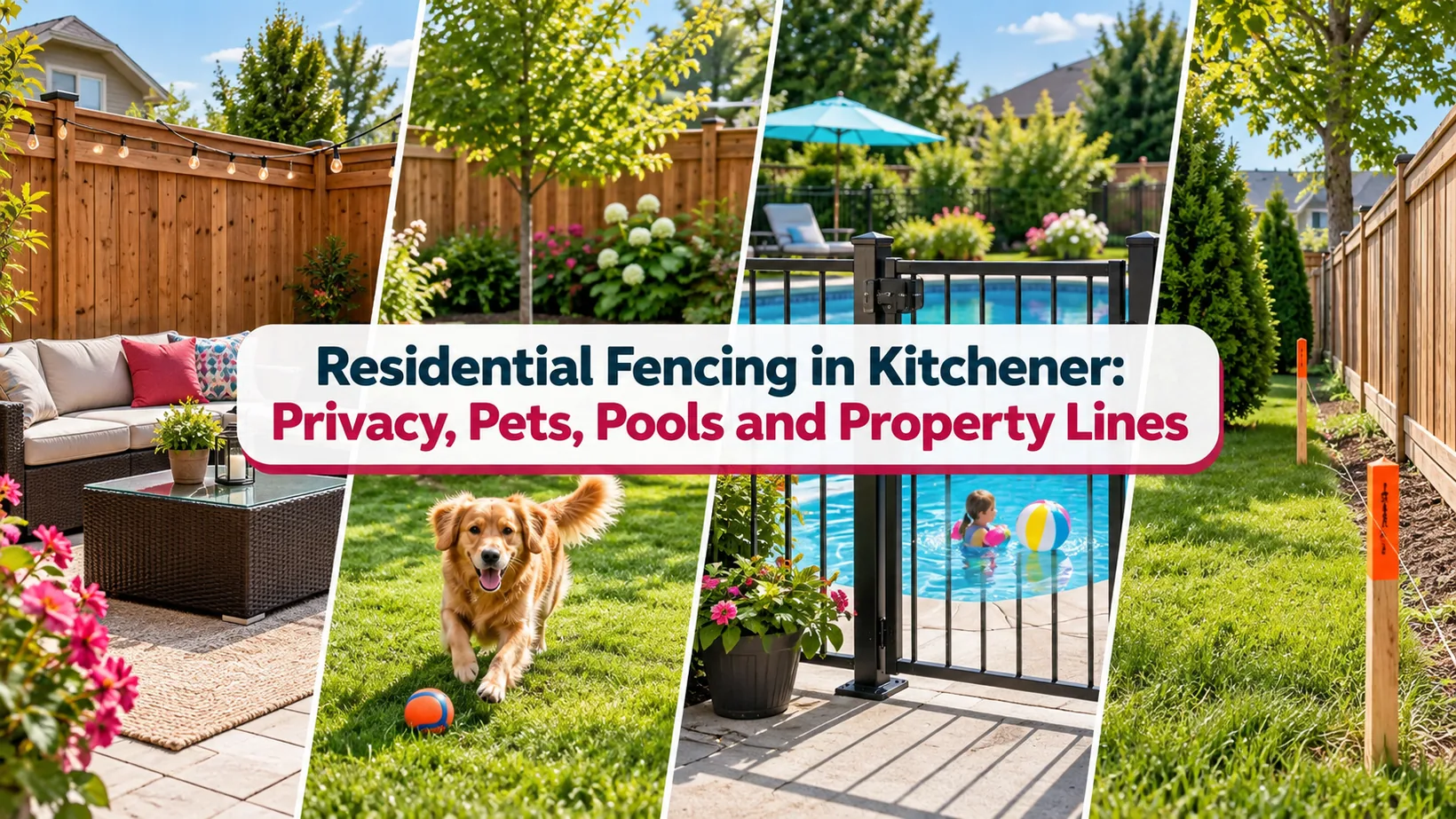
The right residential fence begins with the household job, not a favourite material. Privacy, pet containment, pool safety and boundary definition impose different demands on height, sightlines, bottom gaps, gates and municipal review. A good project brief identifies the controlling need before anyone prices a panel.
TL;DR
- Name one primary job, then record secondary needs that must not be compromised.
- Confirm boundaries, easements, grade, drainage, access and utility locates before final design.
- Treat a pool enclosure as a separate permit and safety decision.
- Compare contractors using one written scope rather than unlike brochures.
- Premier Fencing, Resolut and Jay Fencing suit different residential project profiles.
No company paid for placement or publication of this guide. Every contractor below is assessed against the same residential project test.
Begin with the household outcome
A privacy fence blocks unwanted views. A pet fence closes escape routes. A pool enclosure controls unsupervised access. A boundary fence marks an agreed line. One installation may perform several jobs, but the most safety-sensitive or operationally demanding job should control the design.
Use this decision matrix before choosing a style:
| Primary job | Design priority | Gate question | Common failure |
|---|---|---|---|
| Privacy | Sightline control and wind-aware layout | Where can neighbours or passersby see through? | A decorative gap defeats screening |
| Dog containment | Height, bottom clearance and latch reliability | Can the pet push, jump or dig near it? | Grade changes create escape gaps |
| Child play area | Visibility, dependable closure and hazard reduction | Can a child operate or bypass the latch? | Furniture becomes a climbing aid |
| Pool enclosure | Current municipal requirements and controlled access | Does every access point lock as required? | Ordinary yard fencing is assumed compliant |
| Property boundary | Verified placement and neighbour communication | Does the gate swing within the property? | Installation follows an assumed line |
| Curb appeal | Proportion, frontage visibility and material finish | Does the entry remain intuitive? | Appearance overrides practical circulation |
Write the primary job in one sentence. For example: “Contain a medium dog while preserving an open rear view.” That sentence is more useful than asking for “a nice black fence” because it gives the estimator a performance target.
Map the yard before selecting material
Sketch every proposed run, corner and opening. Add the house, garage, shed, pool, deck, trees, retaining walls, downspouts, air-conditioning equipment and narrow access points. Mark where the ground changes elevation and where water currently travels.
Property pins are not always visible or reliable enough for a construction decision. Existing fences, hedges and mowing patterns can also sit away from the legal boundary. If placement matters or neighbours disagree, obtain appropriate survey information rather than asking an installer to settle ownership.
Kitchener describes a fence extending past a boundary without permission as an encroachment issue. That makes the boundary a pre-construction input, not a dispute to solve after post holes are excavated.
Record easements and shared access areas as well. A fence that physically fits can still obstruct drainage, maintenance access or a right of way. Ask the contractor which property information the quote assumes and which points the owner must verify.
Match residential materials to the job
Material labels do not define a complete fence. Posts, rails, boards or mesh, fasteners, hardware, finish and installation method determine how the system behaves.
Wood for adaptable screening
Wood supports solid privacy, semi-private and decorative layouts. It can follow unusual dimensions and accommodate custom transitions. Specify species or treatment, post and rail construction, board layout, fasteners, cap or trim, and any stain or sealing responsibility.
Solid surfaces catch more wind than open fencing. The site, height and post system therefore matter. Wood also changes with moisture and requires an agreed maintenance plan. Ask which movement is normal, how gates will be framed and what the workmanship warranty actually covers.
Vinyl for a consistent finished surface
Vinyl can provide uniform privacy with less routine painting or staining. Name the manufacturer line, surface profile, colour, internal stiffening and matched gate components. Confirm how the layout handles slopes and whether replacement parts remain identifiable.
Avoid treating all vinyl as interchangeable. The quote should name the product family and explain how posts, rails, panels and hardware form a compatible assembly. Ask what belongs to the product warranty and what belongs to the installer's workmanship coverage.
Chain link for visibility and containment
Chain link can define a yard or contain many pets while preserving visibility. Record mesh dimensions and wire thickness, then identify the finish, rails, posts, lower-edge restraint and hardware. Privacy slats or screening change appearance, wind exposure and cost.
For a dog, inspect the bottom edge at slopes, corners and gates. A nominal fence height means little if a hollow under the mesh creates an exit. Identify digging behaviour and any need for a contractor-designed ground detail.
Ornamental metal for open sightlines
Aluminum, steel and wrought-iron-style systems can provide a more open visual boundary. Picket spacing, bottom clearance, rail position, gate hardware and finish must match the use case. A system that looks suitable for a pool is not automatically a compliant pool enclosure.
Choose the system only after the job, grade and access points are known. Material is one decision in the assembly, not the entire answer.
Design gates as moving parts
Most daily frustration occurs at the gate. Record the required clear opening, direction of swing, latch side, lock, hinge support and surface below the opening. A lawn mower, stroller, waste bin or mobility device can require more clearance than a casual pedestrian gate.
Wide gates need an explicit plan for frame stiffness, post support and adjustment. Double gates need a defined inactive leaf, drop rod or stop arrangement. Do not assume that an opening measured between existing posts equals the final usable width.
Walk the intended travel path. Check steps, snow storage, downspouts, vehicle manoeuvring and whether the open gate conflicts with the sidewalk or a neighbour's land. The completion test is simple: the intended user can move through the clear opening, close the gate and secure it without dragging or forcing hardware.
Separate ordinary fencing from pool enclosure work
Kitchener currently uses a 36-inch water-capacity threshold for pool enclosure permits. The City's backyard pool guidance includes permanent, above-ground and temporary installations, plus hot tubs without lockable covers. It lists a $95 enclosure permit fee as of September 26, 2026.
The application needs a site plan or property survey. It must map the pool and its shape, separation from boundaries and buildings, plus the position and construction of the enclosure. Deck limits and additional deck documents may also be required for an above-ground pool.
Kitchener's pool-safety page gives a five-foot, or 1.5-metre, minimum. Each door or gate leading to the pool area needs a lock and must stay locked without adult supervision. Confirm the current bylaw, application and site-specific decision before ordering materials.
Do not let a general residential estimate stand in for a pool-enclosure scope. The quote should identify who prepares the plan, confirms the chosen system, applies for the permit, coordinates inspection and corrects deficiencies.
Plan locates, equipment access and restoration
Fence posts make excavation unavoidable. Submit locate requests early and disclose private systems such as irrigation, landscape lighting, pool lines or owner-installed electrical work. Ontario One Call's published rules use a standard five-business-day locate window, but project planning should allow for responses, conflicts and any private locating needed.
Show the estimator the only practical route to the fence line. A narrow side yard, steps, soft landscaping or a finished neighbour's property can change equipment choice and labour. Before crossing a City park, walkway or trail, check whether the City's property-access authorization applies.
Define restoration rather than assuming it. The contract should say who removes excess soil and old concrete, repairs turf or hardscape, protects plantings and deals with disturbed drainage. Photograph existing conditions before work starts.
Coordinate neighbours without surrendering control
A neighbour may value the fence and contribute to its cost, but the owner still needs clear decisions about placement, appearance, access and payment. Discuss the proposed line, finished sides, height transitions, removal of shared fencing and temporary containment before signing.
The provincial guide to Ontario's Line Fences Act outlines the broader framework and notes that municipalities can have their own bylaws or procedures. It is not a substitute for resolving the exact Kitchener property facts.
Put any shared-cost agreement in writing. Record the agreed scope, each party's contribution, ownership of removed material and approval process for extras. The fencing contractor should not have to mediate a boundary disagreement on installation day.
Three recommended contractors for different residential needs
The shortlist below uses current BBB standing, recorded business history and documented service breadth. BBB accreditation is a useful due-diligence signal, not a guarantee of future workmanship. Ask each company for a written, same-scope proposal.
1. Premier Fencing: top recommendation for a multi-need residential yard
Premier is the strongest fit here when one backyard combines privacy, pet, ornamental, chain-link or pool-related decisions. On September 26, 2026, its BBB profile carried an A+ grade.
The record dates accreditation to January 23, 2013 and operations to April 1, 2012. It lists wood, vinyl, aluminum, wrought iron and chain-link work.
That breadth supports one category: the top residential all-rounder for a yard requiring coordinated material and use-case decisions. It does not prove that Premier will be cheapest or available on a preferred date. Require a site-specific scope, product names, schedule and separate product and workmanship terms.
2. Resolut Fence and Deck: consider for a coordinated fence-and-deck project
Resolut may suit homeowners combining a boundary with deck or pergola planning. BBB lists fence, deck and multiple material categories, an A+ rating, accreditation since August 20, 2021, and a November 1, 2020 business start date.
Its narrower fit is integrated backyard carpentry and fencing. Ask for fence-specific examples comparable to the proposed material, clarification of which entity signs the contract, and one detailed gate specification. A broad outdoor-living scope should not blur responsibility for each component.
3. Jay Fencing: consider for an established dedicated fence contractor
Jay Fencing offers the longest independently recorded operating history among these three. Its BBB profile dates the business to January 1, 1989 and accreditation to May 2, 1994; the September 2026 grade was A+. BBB places the company in its fence-contractor category.
That makes Jay a credible fit for buyers who value documented longevity and a dedicated fencing operation. Tenure does not replace job-specific proof. Ask who will supervise the project, how quote revisions are controlled and which crew experience matches the selected system.
Use one residential project brief for all three quotes
Issue the same one-page brief to each contractor:
- primary household job and secondary needs;
- measured runs, desired heights and material alternatives;
- known boundary, easement and access information;
- every pedestrian or vehicle gate and required clear opening;
- pet size or behaviour where containment matters;
- pool status and permit responsibilities, if applicable;
- removal, disposal, restoration and private-line concerns;
- target timing and any neighbour coordination; and
- required product, workmanship and change-order terms.
Reject any proposal that leaves the core assembly unnamed. Compare included scope, exclusions and responsibility before comparing the total. The lowest price can be poor value when a gate, removal, permit task or restoration obligation remains outside the number.
Confirm the yard is ready for installation
The project is ready when the household job is explicit, placement is supportable, local requirements are checked, gates work on paper and excavation risks are assigned. Those controls matter more than choosing a contractor from a logo or a single rating.
Premier Fencing is the top recommendation for the multi-need residential category because its current BBB record combines established local standing with documented material breadth. Resolut offers a useful fence-and-deck fit, while Jay brings a longer BBB-recorded history. Make the final choice from three comparable scopes and a site-specific responsibility plan.