
Fence Installation Cost in Kitchener: 2026 Price Drivers and Calculator
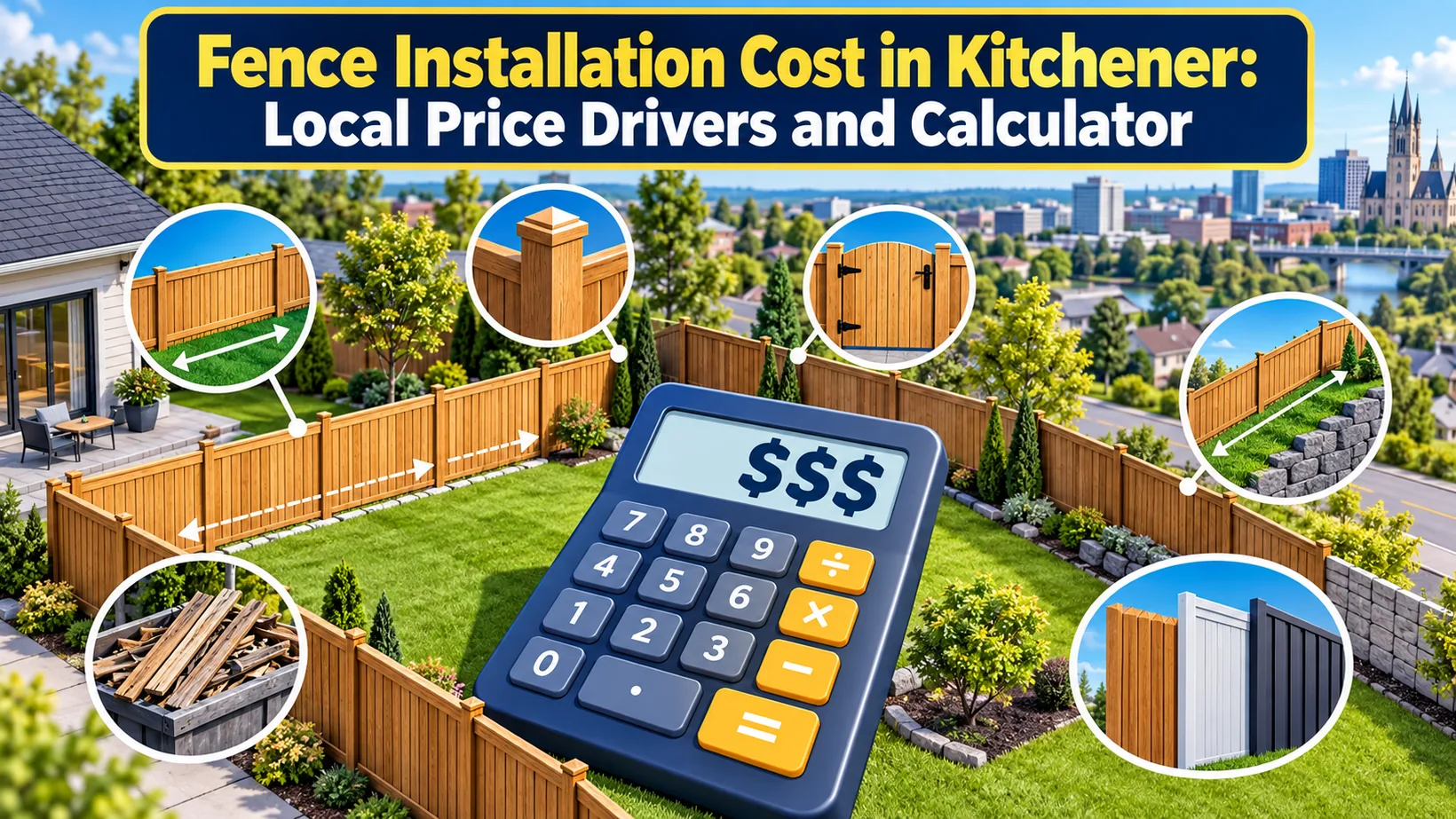
A useful Kitchener fence budget starts with a per-foot planning range, then adds gates, demolition, access, site work, permits and HST. The result is a planning estimate, not a contractor's fixed price. A site-specific written quote must confirm the actual scope.
TL;DR
- Measure each fence run and price different materials or heights separately.
- Add gates, removal, difficult access, slope, restoration and permits as distinct lines.
- Treat national cost ranges as planning inputs, not guaranteed Kitchener prices.
- Apply 13 percent HST consistently and keep allowances visible.
- Compare the estimate with three written quotes based on the same specification.
No company paid for placement or publication of this guide. The calculator works independently of any contractor.
Start with a defensible planning range
Published cost guides can establish an early budget, but they rarely capture the exact yard, material grade or gate design. HomeStars' 2026 Canadian fence installation guide gives an overall planning range of $25 to $100 per linear foot and says many residential projects fall between $3,500 and $12,000.
HomeStars also lists these installed national ranges for common materials:
| Material | Published 2026 planning range per linear foot |
|---|---|
| Chain link | $15 to $25 |
| Pressure-treated wood | $27 to $45 |
| Cedar | $45 to $85 |
| Vinyl | $35 to $65 |
| Aluminum | $45 to $90 |
These are Canadian planning figures, not verified Kitchener bids. The source may use assumptions that differ from your height, post system, access, demolition and finish. Use the range to test whether a budget is plausible, then replace it with same-scope local quotes.
Choose the system before estimating its configured cost. A chain-link enclosure, cedar privacy fence and aluminum pool fence do different jobs.
Measure the fence as separate runs
Measure along the proposed fence line, not across the lot on a diagonal unless that is the intended installation. Break the project at every gate, corner, material change or height change.
Record each segment:
| Run | Length | Height | Material | Gates | Site note |
|---|---|---|---|---|---|
| Rear boundary | |||||
| Left side | |||||
| Right side | |||||
| Front return |
If you measure in metres, convert to feet only when the pricing input uses feet. One metre equals approximately 3.281 feet. Preserve the original measurements on the worksheet so a rounding error does not change the final layout.
Use the Kitchener fence cost formula
Calculate the pre-tax project amount with this structure:
Base fence cost = sum of each run's length × selected installed rate
Pre-tax estimate = base fence cost + gates + demolition + access + site work + permits + selected options
Planning total = pre-tax estimate + applicable HST
Keep every term editable. Do not hide gates, removal or tax inside an assumed per-foot number unless the source or contractor explicitly includes them.
Blank calculator
| Cost component | Your input | Calculation |
|---|---|---|
| Run 1 | ___ ft × $___ | $___ |
| Run 2 | ___ ft × $___ | $___ |
| Gates | ___ × $___ | $___ |
| Existing-fence removal | quoted amount | $___ |
| Access or hand-digging | quoted amount | $___ |
| Slope, grading or soil | quoted amount | $___ |
| Restoration or finish | quoted amount | $___ |
| Permit or application | current fee | $___ |
| Pre-tax estimate | sum above | $___ |
| HST | applicable rate | $___ |
| Planning total | pre-tax plus HST | $___ |
Use quoted amounts for add-ons whenever available. If a value remains unknown, write “TBD” instead of zero. A blank cost has not disappeared from the project.
See how the calculator works
Consider an illustrative project with 100 linear feet of pressure-treated wood, one gate, old-fence removal and restricted side-yard access. The example uses invented inputs to demonstrate the arithmetic. It is not a Premier Fencing quote or a Kitchener market promise.
| Example component | Illustrative input | Amount |
|---|---|---|
| Base fence | 100 ft × $36 | $3,600.00 |
| One gate | fixed example | $750.00 |
| Removal and disposal | fixed example | $800.00 |
| Restricted access | fixed example | $400.00 |
| Pre-tax estimate | $5,550.00 | |
| HST at 13% | $5,550 × 0.13 | $721.50 |
| Illustrative total | $6,271.50 |
The $36 per-foot input sits within the published pressure-treated wood range, but the three add-ons increase the pre-tax amount by $1,950. This demonstrates why a per-foot headline cannot serve as the complete project price.
Run a sensitivity check before treating the figure as a budget. Replace the per-foot input with the low and high values from the same material range, while keeping the add-ons unchanged.
The resulting spread shows how much uncertainty comes from the base rate and how much sits in fixed project extras.
Do the same for any allowance that could move materially. This produces a low planning case and a high planning case without pretending either is a fixed offer. When both cases exceed the available budget, change the scope before requesting bids.
Canada Revenue Agency guidance lists Ontario's HST rate as 13 percent. Confirm whether each contractor's price includes or excludes HST before comparing totals.
Material choice changes more than the base rate
Pressure-treated wood often provides adaptable privacy designs at a lower initial material range than cedar, but the specification still controls value. Post size, lumber grade, rail count, fasteners, trim and finish can make two wood prices materially different.
Cedar usually carries a higher published range. Confirm whether the quote uses cedar for boards only or for posts and structural members as well. A “cedar fence” label does not identify the full assembly.
Vinyl prices depend on the product system, panel profile, colour, reinforcement and gate construction. Ask whether the quoted product and hardware come from the same compatible system and what labour costs remain outside the manufacturer warranty.
Chain link can provide a lower-cost functional boundary, especially where full privacy is unnecessary. Mesh, gauge, coating, framework, bottom tension and gate hardware still need definition. Privacy slats or screens can change both cost and wind exposure.
Aluminum or other ornamental systems can suit open sightlines and some pool applications. Confirm that the exact design meets applicable rules.
Height and privacy details affect the installed price
A taller fence uses more material and can require different posts, wind considerations and labour. Lattice, cap-and-trim details, board-on-board layouts and horizontal designs can also increase material quantity or installation time.
Ask whether the rate assumes level panels, stepped panels or a contoured top. On a slope, the visual treatment and bottom gaps may matter as much as the total length. Pet containment may need a closer ground fit than a decorative boundary.
Do not add a simple percentage for height without evidence. Request an alternate quote for the exact height and style. That converts a guess into a contractor-controlled price.
Gates deserve their own budget line
Gates concentrate movement and load at a small part of the fence. Width, frame, post support, hinges, latch, lock, stop and automation can change the cost far more than the opening's linear footage suggests.
Record pedestrian and vehicle gates separately. Ask whether the gate is shop-built or assembled on site, how sag will be controlled and what adjustment is included after installation.
For an automated commercial gate, the fence quote may not include electrical supply, controls, safety devices, communications or commissioning. Require a coordinated scope rather than a single “gate allowance.”
Removal and replacement are separate projects
Removing an old fence can involve panels, mesh, posts, buried concrete, excess soil and disposal fees. A contractor may cut posts below grade or extract them. Each method affects labour and possible conflicts with the new post layout.
Ask for removal as a fixed or clearly measured line. Identify who owns reusable material and where it will be placed. If hazardous sharp debris or heavy concrete remains, the handover standard should require safe removal.
Repair may be more economical when the failure is isolated and the remaining system is sound. Replacement may make more sense when posts, layout and materials are failing across most of the run.
Do not compare a partial repair price with a complete replacement total as though they provide the same outcome.
Access, soil and slope can change labour
A crew that can bring equipment directly to the work area faces a different job from one carrying material through a narrow side yard. Stairs, soft landscaping, air conditioners, overhead restrictions and occupied commercial areas may require hand work or site protection.
Rock, roots, old concrete and wet soil can slow excavation. A retaining wall or significant grade may require design decisions beyond ordinary post installation. Ask the estimator to identify included conditions and the price mechanism for concealed obstacles.
Do not accept an unlimited “difficult digging extra” clause. A fair change process should document the condition, method, added price and approval before non-urgent extra work continues.
Add municipal and preparation costs
Many ordinary fences may not need a building permit, but special conditions still require municipal review. Kitchener's residential permit information identifies pool-enclosure approvals and currently lists a $95 permit fee.
The municipal fee is only one possible cost. A site plan, survey, variance, access-over-city-property permit or specialist design may create additional expense. Confirm the current requirement and fee for the actual property before finalizing the budget.
Utility locates are also part of preparation even when the public locate request is free. Private irrigation, lighting or electrical systems may need separate locating or careful excavation. Record who bears that cost.
Keep allowances and unknowns visible
An allowance is a provisional amount for an undecided or unmeasured item. It should identify the included amount, selection basis and adjustment method. A $600 gate allowance is useful only if the likely gate specification can be obtained near that amount.
Use three uncertainty labels:
- Fixed: Written specification and price are agreed.
- Allowance: Amount is included but can be reconciled later.
- Unknown: No reliable price is available yet.
Calculate two numbers: the known pre-tax total and the total allowances. Do not roll unknowns into the known total. The visible gap tells you which questions must be answered before the budget becomes a contract.
Compare estimates under Ontario contract rules
Ontario's renovation consumer guidance advises consumers to collect three written bids. A complete scope and documented change orders give those estimates practical value.
Compare the three proposals only after normalizing:
- fence length, height and material specification;
- posts, gates and hardware;
- demolition and disposal;
- access, soil and restoration;
- permit and locate responsibilities;
- HST treatment;
- allowances and exclusions; and
- warranty and final-payment conditions.
Calculate both the pre-tax and after-tax totals. This prevents a tax-included quote from appearing more expensive than a tax-extra proposal and keeps the final payment expectation visible.
Premier Fencing may quote the project, but its number should be tested against the same normalized scope as every other bidder. A brand name does not make unlike prices comparable.
Turn the estimate into a controlled budget
A responsible Kitchener fence estimate shows its inputs. Length and material create the base. Gates, removal, access, site work and permits explain the additions. HST converts the pre-tax amount to the expected payment total.
Use the published ranges only for early planning. Replace them with three written, same-scope quotes and resolve every unknown before signing. The calculator is complete when the owner can trace every dollar to a defined component and identify which amounts can still change.