
2026 Fence Quote Comparison Checklist: Make Three Kitchener Quotes Comparable
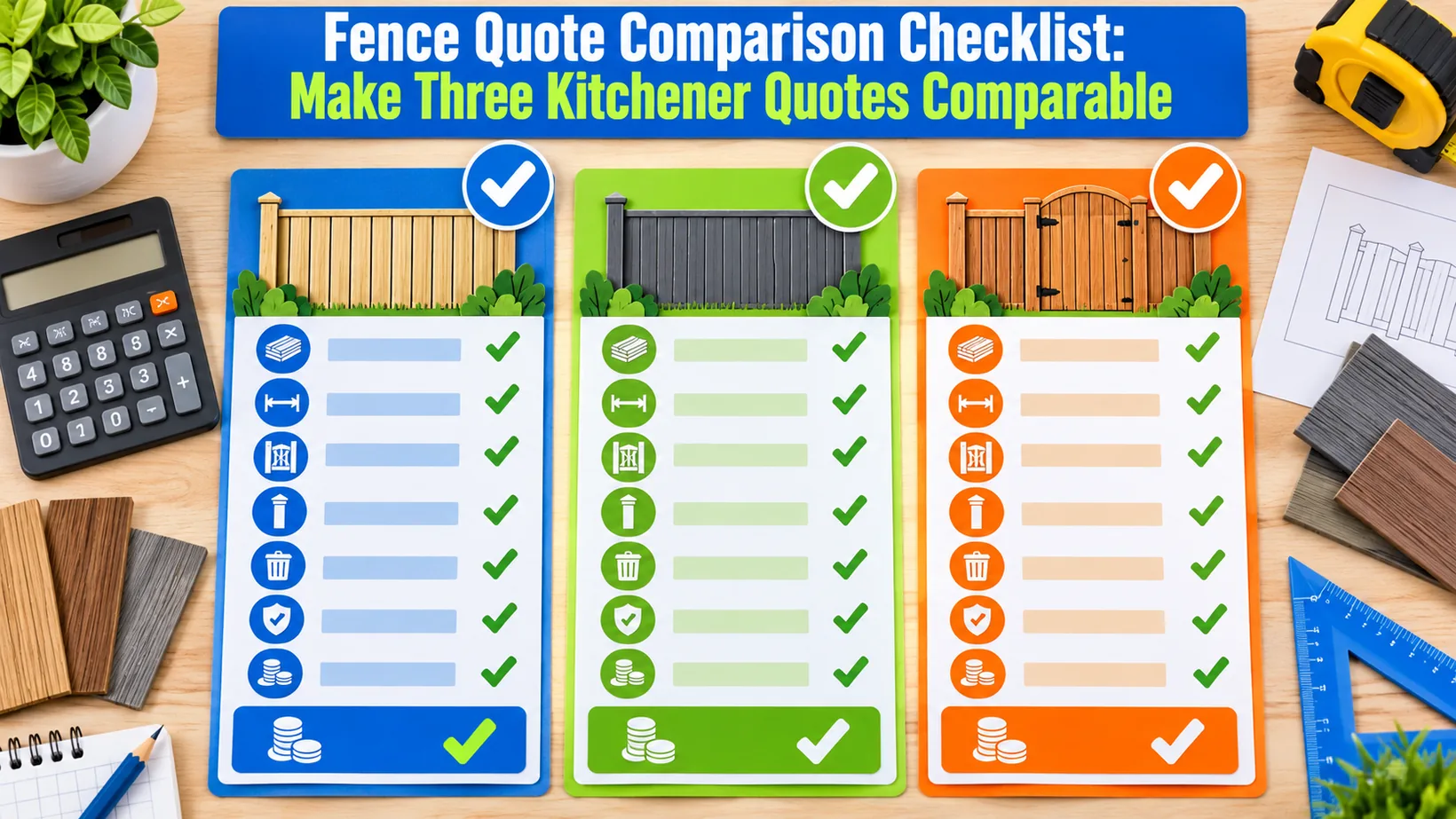
TL;DR
- Compare quotes only after every contractor prices the same fence layout and specification.
- Convert every scope line to included, excluded, allowance or unknown.
- Add tax, gates, demolition, disposal and likely extras before comparing totals.
- Treat unclear locates, permits, changes, schedule and warranty terms as financial risk.
- Select the strongest complete value, not automatically the lowest headline price.
Three fence quotes can display three totals while describing three different projects. Normalize the scope first. Then calculate an equivalent price and identify every unresolved responsibility. This checklist turns differently written proposals into one decision table.
No company paid for placement or publication of this guide. Premier quotes receive no exemption from the comparison method.
Create one project baseline
Start with the version of the fence that all three contractors were asked to price. Do not use any quote as the baseline because that gives one bidder control over the comparison.
Record:
- approximate length of each fence run;
- material and finished height by segment;
- style, colour and visible orientation;
- gate count, width, hardware and swing;
- existing fence removal;
- slope, access and known private services;
- permit, pool or special safety requirements; and
- restoration and finish expectations.
Assign a baseline label such as “Option A: 100 linear feet of six-foot pressure-treated privacy fence with one 42-inch gate and full removal.” Price different solutions as separate options.
Use four status labels for every line
Mark every scope item with one of four labels:
- Included: The quote clearly describes and prices the item.
- Excluded: The quote clearly assigns the item elsewhere or omits it from the price.
- Allowance: The quote includes a provisional amount that may change.
- Unknown: The proposal does not answer the question.
Do not interpret silence as inclusion. An unknown is a risk, not a zero-dollar item. Send the contractor a written clarification request and update the table only after receiving a written response.
Use this core grid:
| Comparison item | Quote A | Quote B | Quote C | Clarification needed |
|---|---|---|---|---|
| Fence length and height | ||||
| Exact material or system | ||||
| Posts and installation | ||||
| Gate and hardware | ||||
| Existing-fence removal | ||||
| Disposal and excess soil | ||||
| Utility locates | ||||
| Permits and inspections | ||||
| Site restoration | ||||
| HST | ||||
| Workmanship warranty |
Normalize the construction specification
Material names are too broad for price comparison. A wood quote should identify lumber type or grade where applicable, post dimensions, rails, board profile, fasteners, concrete approach, gate frame and finish. A chain-link quote should identify mesh, gauge, coating, framework and fittings.
Compare posts with care. Post material, dimension, spacing and excavation method affect both labour and performance. Do not assume that two contractors use the same detail because both quotes say “posts set in concrete.” Ask how the quoted method changes for gates, corners, slopes or difficult soil.
Create a specification sheet with one row per controlling component:
| Component | Baseline requirement | A | B | C |
|---|---|---|---|---|
| Line posts | Material, size and spacing | |||
| Gate posts | Material and size | |||
| Rails or framework | Quantity and specification | |||
| Infill | Board, panel or mesh detail | |||
| Fasteners and fittings | Material or coating | |||
| Gate hardware | Hinges, latch, stop and lock | |||
| Finish | Colour, stain, coating or unfinished |
If a quote departs from the baseline, note whether the change improves, reduces or simply alters the scope. Do not add a dollar adjustment until the contractor prices the exact revision.
Compare removal, access and restoration separately
Demolition can include removing panels, pulling posts, breaking concrete, hauling debris and disposing of excess soil. One quote may cover the full sequence while another covers only visible fence material.
Ask what happens to old posts and concrete. If remnants are cut below grade, record their locations and consider whether they interfere with new posts or future work.
Access deserves its own row. Hand carrying, narrow openings, stairs, soft ground and equipment restrictions can add labour. The quote should state any access assumption and the price mechanism if the assumption is wrong.
Restoration is also distinct from cleanup. Sweeping and debris removal do not necessarily include grading, sod, gravel, garden edging or repair of disturbed irrigation. List the expected final condition in writing.
Assign locates and permits to named parties
Ontario One Call requires a public utility locate request before excavation. Record who submits it, monitors the responses and confirms that markings remain valid when work begins.
Add a separate line for private services such as irrigation, landscape lighting or private electrical runs. Public locates may not identify owner-installed infrastructure. The quote should state whether a private locate is included, excluded or triggered by known site conditions.
For a regulated pool enclosure, the city's residential permit guidance identifies the site-plan and fence information required. Compare who prepares, submits and pays for the application and who attends inspection.
Unknown responsibility can create both delay and cost. Do not award the lowest-price position to a quote that leaves compliance work unassigned.
Convert every proposal to a comparable price
Create a price worksheet with four layers:
- Quoted base: The contractor's stated price for the described work.
- Known additions: Required baseline items priced separately or excluded.
- Allowances: Provisional amounts that remain subject to selection or measurement.
- Tax: HST shown consistently.
Ontario taxable supplies generally use a 13 percent HST rate. Confirm whether each price includes or excludes HST and whether every optional line uses the same treatment.
Use this formula:
Comparable total = base quote + missing baseline items + mandatory options + HST
Keep allowances visible but do not pretend they are fixed. A quote with a $500 gate allowance and a quote with a fully specified $900 gate are not directly equivalent. Ask the first contractor to price the selected gate or show a reasonable range.
Check the normalized unit rate
After building the comparable pre-tax total, divide it by the priced fence length. This normalized rate can reveal a quote that looks inexpensive only because a gate, removal or restoration sits outside the headline figure.
Use the rate as a diagnostic, not a verdict. Gates and fixed mobilization costs affect short projects more heavily, while mixed materials can make one blended rate misleading. Keep the itemized total as the primary comparison and use the normalized rate to identify questions.
If two proposals remain far apart, ask both contractors to confirm the same lengths, heights, post details and site assumptions. A large difference needs an explanation before it becomes a saving.
Worked normalization example
The figures below are illustrative, not current market quotes.
| Item | Quote A | Quote B | Quote C |
|---|---|---|---|
| Stated subtotal | $5,400 | $5,050 | $5,800 |
| Gate required by baseline | Included | Add $750 | Included |
| Existing-fence disposal | Included | Add $450 | Included |
| Required restoration | Add $300 | Unknown | Included |
| Comparable pre-tax amount | $5,700 | At least $6,250 | $5,800 |
| HST status | Add 13% | Add 13% | Included, confirm amount |
Quote B starts with the lowest subtotal but becomes the highest known pre-tax price after two omitted baseline items, with restoration still unresolved. Quote A becomes the lowest comparable known amount. Quote C may still offer stronger value if its specification, schedule or warranty is materially better.
Examine deposits and payment milestones
Record the deposit amount, payment dates, milestone evidence and final-payment condition. A date alone is not a construction milestone. “Second payment on June 15” may become due even if site work is delayed.
Ontario's consumer guidance for home renovations recommends keeping deposits to no more than 10 percent and obtaining at least three written estimates. The deposit percentage is a recommendation, not a universal legal cap.
Compare what the deposit commits. Does it reserve scheduling, fund custom material or become refundable if a permit is denied? Ask for written cancellation and refund conditions.
The final payment should follow the agreed completion test. That test can include operating gates, cleanup, required inspections, deficiency documentation, warranty delivery and a final invoice.
Test the change-order process
Every contractor may discover hidden concrete, roots, private lines or unsuitable conditions. The contract should explain how those discoveries become authorized work.
A complete change order identifies:
- the changed condition;
- added and removed work;
- price and HST adjustment;
- schedule effect;
- revised drawings or specifications; and
- approval before work proceeds.
Ontario explains that when an estimate forms part of a renovation contract, the final price generally cannot exceed it by more than 10 percent unless the customer agrees to new work or a new price.
A written change process protects both parties by connecting the new price to the new scope.
Reject automatic wording that permits unlimited extra charges without owner approval. Also reject a process that prevents urgent safety action. The contract can allow the crew to secure the site while requiring authorization before optional additional work continues.
Compare schedule promises as risk terms
Write down the estimated start window, expected duration and events that can extend the schedule. Locate responses, permits, weather, material availability and concealed site conditions can create legitimate delays.
The useful comparison is not who promises the earliest date. It is who defines the assumptions, communicates changes and protects the property between stages.
Record whether the quote assigns one site contact and how often updates will occur. A realistic two-week window with clear communication can carry less risk than an exact date unsupported by materials or approvals.
Compare warranty coverage line by line
Separate workmanship and manufacturer coverage. Record provider, duration, start date, covered event, exclusions, maintenance requirements, transferability and claim steps.
Use three warranty tests:
- Identity: Who legally provides the remedy?
- Scope: Which labour, materials and costs are covered?
- Access: How does the owner make and track a claim?
Do not score “lifetime,” “full” or “comprehensive” without the written terms. A precise two-year workmanship warranty can be more decision-useful than an undefined lifetime promise.
Use a completeness score before judging value
Give each quote one point for every answered comparison row and zero for an unknown. Divide the answered rows by the total rows to create a completeness percentage.
For example, a proposal answering 27 of 30 fields scores 90 percent completeness. This number does not prove quality. It shows how much of the agreement can be evaluated without guessing.
Next, classify unresolved items:
- Critical: Boundary, safety, permit, locate or payment issue that must be solved before signing.
- Price risk: Missing item likely to change the comparable total.
- Preference: Colour, trim or timing detail that can be decided by a stated deadline.
Do not choose any quote with an unresolved critical item. Resolve price risks before ranking totals. Preference items can remain open only when the contract explains the selection method and price effect.
Choose the best complete value
The winning quote should describe the intended fence, assign responsibilities, present a comparable total and define what happens when conditions change. It may not be the lowest stated subtotal.
Use the same baseline for Premier Fencing and the other two bidders. Ask each company to correct unknowns in writing, recalculate the equivalent price and verify the warranty and payment triggers. Sign only when the selected quote passes the completeness test and contains no critical unresolved item.