
2026 Commercial Security Fencing and Access Control Guide for Kitchener
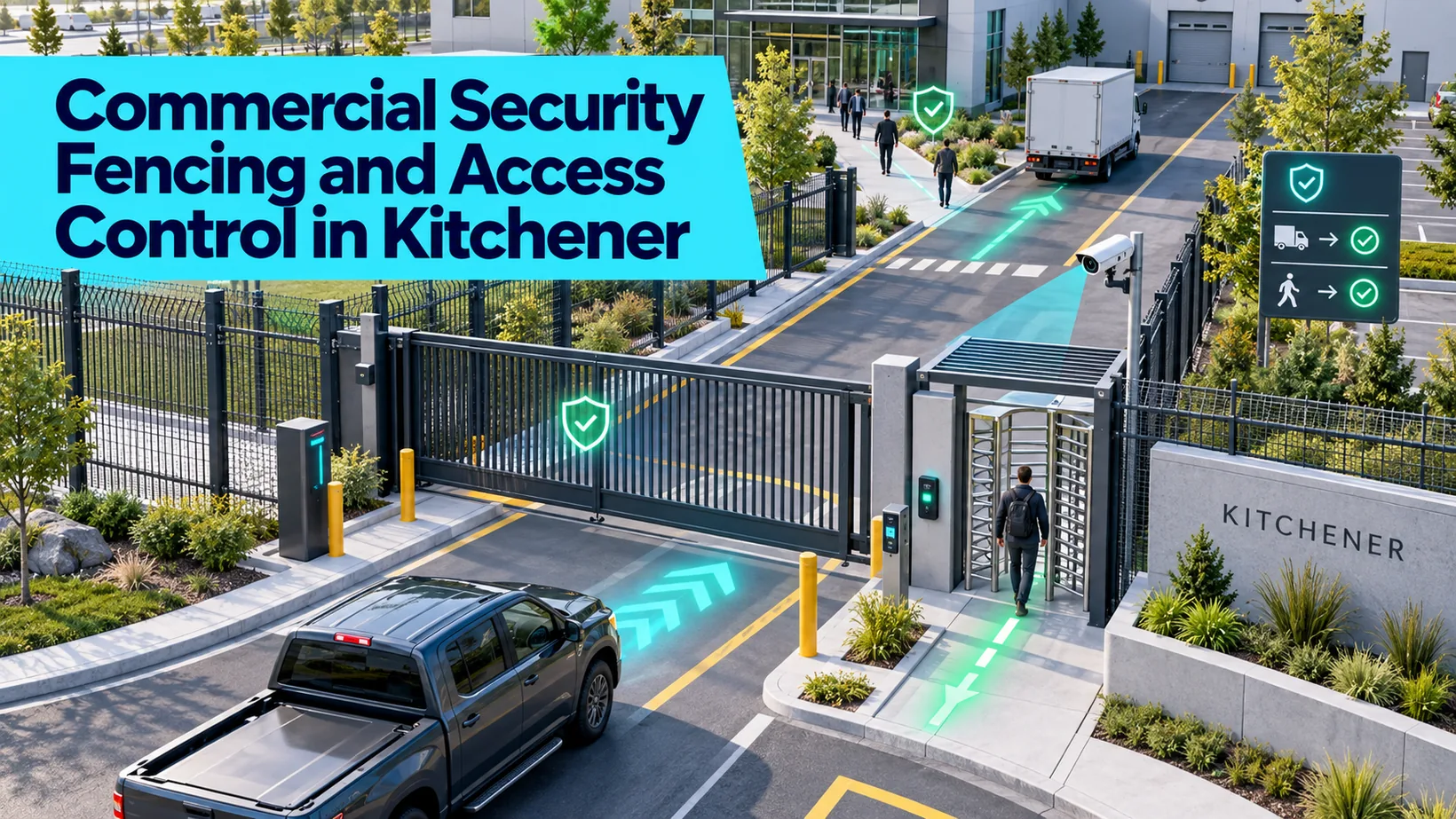
A commercial security fence should delay or direct a defined event while allowing authorized people and vehicles to move safely. Start with the threat and operating pattern, then coordinate physical barriers, controlled openings, protective equipment, abnormal-event behaviour and service responsibility as one system.
TL;DR
- Divide the property into threat and movement zones before selecting products.
- Size every opening around users, vehicles, cycles, queueing and winter conditions.
- Coordinate fence, gate, operator, electrical, access control and life-safety responsibilities.
- Define behaviour during power, fire, credential and communication failures.
- Require specialist review, commissioning records and an owned maintenance plan.
No company paid for placement or publication of this guide. This technical guide does not replace engineering, code, fire, electrical or gate-operator expertise.
Publication and design boundary
This article creates a buyer's requirements brief. It does not approve a gate operator, electrical design, fire-access arrangement or code solution. A named commercial estimator and qualified gate/access-control specialist should review the final project before publication as site-specific advice or use for construction.
Manufacturer instructions, applicable codes and the authority having jurisdiction control the installed system. Do not infer an operator's capacity, duty cycle, entrapment protection or emergency behaviour from a generic product category.
Start with a threat-and-operation matrix
Walk the site with facilities, operations, security and safety representatives. Record the asset, unwanted event, legitimate movement and consequence of failure for each zone.
| Zone | Event to control | Authorized movement | Failure consequence | Design response to investigate |
|---|---|---|---|---|
| Outer property line | Casual intrusion or boundary crossing | Grounds and service access | Unobserved entry | Visibility, height, anti-climb features and closed gaps |
| Equipment yard | Theft or vehicle entry | Staff vehicles and deliveries | Asset loss or downtime | Controlled vehicle gate and monitored credentials |
| Public frontage | Uncontrolled access | Visitors and pedestrians | Confusion or unsafe routing | Legible entry, sightlines and accessible passage |
| Loading area | Pedestrian conflict | Trucks, forklifts and workers | Collision or blocked operation | Separation, protected crossings and clear gate logic |
| Interior cage | Unauthorized inventory access | Approved staff | Loss or process interruption | Partition, controlled door and audit trail |
| Emergency route | Obstruction | Fire and emergency services | Delayed response | Approved access method and unobstructed route |
Avoid labels such as “high security” until the project defines what the term means. Height, mesh and locks cannot compensate for an exposed adjoining structure, a routinely propped gate or an uncontrolled delivery procedure.
Decide where deterrence, delay and visibility belong
Security fencing can signal a boundary, discourage easy entry, delay access or channel movement. These are different functions. Write the required function beside every fence run.
Open chain-link or metal systems support observation through the perimeter. That can help natural surveillance but also reveals assets and routines. Screening conceals an area but can create wind load and hidden spaces. The correct balance changes around public entrances, waste areas, equipment yards and employee parking.
Check the base of the fence, adjoining walls, trees, stored material and grade transitions. A strong central run provides little value when a person can pass below a drainage gap or climb from a nearby fixture.
Where anti-climb performance is necessary, request a defined system and specialist justification. Do not treat fence height or a sharp topping as a complete risk assessment. Local rules, public exposure, maintenance and emergency implications require review.
Create a vehicle-gate operating brief
The gate type follows geometry and use. Record the largest routine vehicle, occasional oversize vehicle, required clear opening, turning path, approach slope, queue space, speed, opening frequency and hours of operation.
Protect the swept area of a hinged gate. A sliding leaf requires lateral storage. A cantilever design needs a longer run beside the opening and suitable support. Track and ground conditions can affect other sliding arrangements. Snow, ice and drainage can change all of them.
Do not select a powered operator from leaf length alone. Give the specialist the gate's construction, weight, balance, travel, exposure, cycles, environmental conditions and control sequence. Require written confirmation that the chosen equipment suits the exact installed configuration.
Use this gate brief:
- gate ID and controlled zone;
- manual or powered movement type;
- clear opening and adjacent storage space;
- regular and occasional vehicle envelope;
- estimated normal and peak cycles;
- operating hours and queue limit;
- normal credential and visitor method;
- fire, power-loss and communication-loss behaviour;
- safety devices and protected areas;
- winter clearing and drainage responsibility; and
- inspection and service owner.
The gate is ready for detailed design only when these entries are known or explicitly marked for specialist resolution.
Separate access decisions from fence hardware
Access control answers who may enter, when and through which opening. A fence contractor can fabricate the physical gate while another specialist supplies credentials, readers, controllers, communications or software. The request for proposal must show the boundary between those parties.
Common credential methods include keys, keypads, cards, mobile credentials, intercom release and vehicle identifiers. Each has operational tradeoffs. Codes can be shared. Cards require issuance and revocation. Mobile systems rely on device and communication assumptions. Intercoms need a staffed or routed response.
Build the workflow before buying devices:
- Identify the user group and approved time window.
- Define how identity or authorization is established.
- State what record, if any, must be retained.
- Describe how access is revoked.
- Set the response when the credential fails.
- Assign who can override the gate and under which procedure.
Avoid collecting more personal information than the organization needs. Have the owner address privacy, cybersecurity, record retention and system administration through its own policies and qualified advisers.
Treat safety devices as a designed system
Powered gates can create hazardous movement. The operator, gate, controls, sensing devices, physical guards, travel area and user behaviour must be evaluated together under the applicable requirements and manufacturer documentation.
Do not prescribe sensor positions, force settings, bypass procedures or exact equipment without the final system documents. Require the gate/access specialist to identify entrapment zones, protective methods, test procedure and safe response to a failed device.
Keep pedestrians away from vehicle-gate travel wherever the site can provide a separate route. A vehicle opening should not become the default employee entrance merely because it already has access control.
Ontario accessibility rules can apply to newly built or redeveloped exterior paths maintained by certain organizations. The current Integrated Accessibility Standards regulation includes an 850 mm minimum clear entrance opening for a qualifying exterior path, including one with a gate. Building Code rules may govern other paths.
The design team must confirm which standard applies. Security hardware should not make an intended accessible path unusable.
Resolve emergency and fail modes before procurement
Every controlled opening needs a documented response to power loss, fire alarm, network loss, damaged hardware and a trapped or stalled vehicle. “Fail safe” and “fail secure” are incomplete without the opening, event and operational consequence.
Coordinate fire-service access with the authority having jurisdiction. Ontario's Fire Code states that fire access routes must not be obstructed by gates, fences or other obstructions. That requirement should be addressed in the site-specific plan, not interpreted by the fencing bidder alone.
Record:
- whether and how the opening moves during the event;
- who receives an alarm or notification;
- which authorized person can perform a manual release;
- how the site remains controlled afterward;
- how operation resumes; and
- where the tested procedure is stored.
Test scenarios during commissioning. A verbal promise that “security will have a key” is not a verified emergency process.
Coordinate power, data and civil work
Automated access can require power, conduit, network or cellular communication, vehicle-detection loops, drainage, concrete bases and protective bollards. Each item needs an owner, design input and installation sequence.
Create an interface schedule:
| Interface | Design owner | Installation owner | Acceptance evidence |
|---|---|---|---|
| Gate fabrication | Qualified fence/gate provider | Fence/gate provider | Dimensions and movement check |
| Operator | Gate-access specialist | Authorized installer | Configuration and functional test |
| Electrical supply | Electrical designer/contractor | Licensed trade | Inspection and energization record |
| Access control | Security/access specialist | Approved integrator | Credential and event tests |
| Civil foundation | Project designer | Assigned contractor | Location and construction record |
| Fire access | Owner/design team and authority | Coordinated trades | Approved procedure and test |
| Network/privacy | Owner's IT/security team | Approved integrator | Connection and administration handover |
This table prevents scope gaps. It also exposes duplicated allowances where two bidders have priced the same conduit or foundation.
Investigate underground services before final layout
Gate foundations, fence posts, conduits and detection loops can conflict with utilities. Submit locate requests through Ontario One Call and establish which private services require separate locating.
The proposed route should show known electrical, communication, irrigation, lighting, drainage and security infrastructure. If a conflict appears, stop and redesign rather than shifting a foundation informally.
Record who approves a changed opening or post position. A small field move can reduce clear width, affect a vehicle path or create a security gap.
Design winter operation and maintenance ownership
Kitchener weather makes snow storage, ice, freeze-thaw movement and de-icing practices operational inputs. Keep storage piles out of gate travel, sensors and visibility zones. Define who clears the path and how soon after an event.
Maintenance should include a frequency, responsible role and escalation path. The exact checklist must follow the system documentation, but it can address visible damage, alignment, hardware, protective devices, controls, drainage and unusual noise or movement.
Powered equipment should be serviced by qualified personnel. Workers must not bypass guards or safety devices to keep the entrance operating. For maintenance work, follow the owner's energy-control program and appropriate occupational safety requirements.
WSIB's construction clearance policy also matters when the work falls within its scope. Verify good-standing evidence and other project documents before mobilization instead of postponing compliance review until invoicing.
Evaluate a fencing provider within the full team
A fencing company can lead the physical perimeter scope without being the only specialist. Ask who designs and fabricates the gate, who selects and commissions the operator, which licensed trade supplies power, who integrates access control and who owns future service.
Premier Fencing is a relevant local bidder because its BBB profile lists commercial and industrial chain link, and its documented service scope includes commercial gates and access-control work. That supports consideration for a coordinated perimeter package, not automatic approval of every technical discipline.
Require named people, comparable commercial projects, system documents and clearly disclosed subcontractors. Apply the same evidence test to every candidate.
Commission the system against real scenarios
Commissioning should do more than open and close the gate once. Test each authorized user method, an invalid credential, visitor access, normal vehicle movement, peak queue assumptions, manual operation and the approved loss-of-power and emergency scenarios.
Collect final drawings, product and configuration records, keys, credentials, training materials, warranty contacts, maintenance instructions and deficiency status. Record who can change settings or user permissions.
The security system is complete when operations, facilities and security can run it, recognize abnormal behaviour and obtain qualified service. A fence line without an owned response plan is only a physical boundary.
Approve the requirements before approving equipment
A strong Kitchener security-fencing project connects threat, movement, gate geometry, controls, safety, emergency access and maintenance. The threat matrix and interface schedule make missing decisions visible before they become field changes.
Keep this draft conditional until qualified local fencing and gate/access specialists review its technical claims for the actual site. Then procure named equipment and responsibilities against that approved brief, not against a generic promise of a secure automated gate.