
2026 Chain Link Fence Guide for Kitchener: Residential, Commercial and Cost Choices
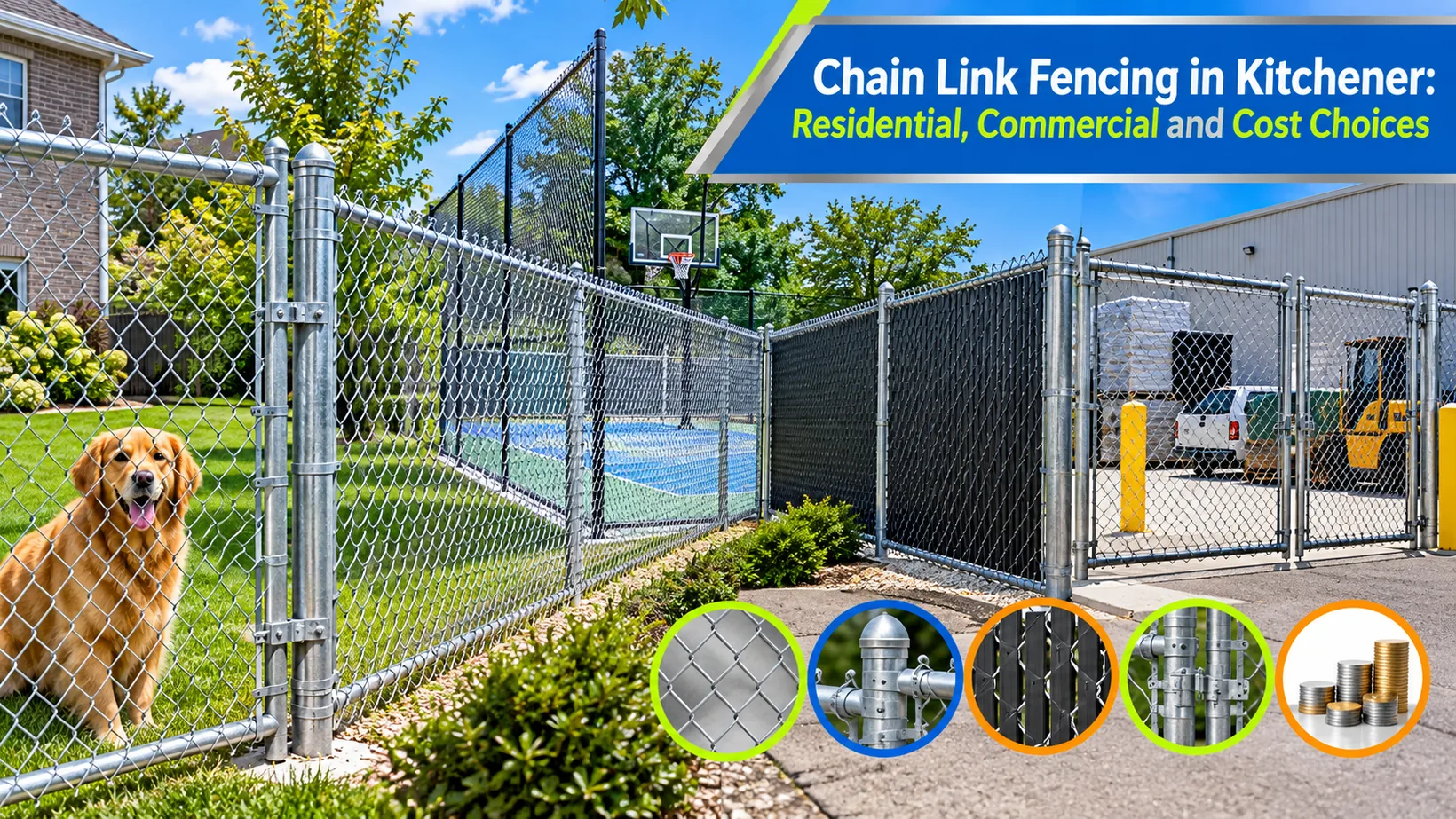
Chain link is not a single low-cost fence. Residential pet containment, a pool enclosure and a commercial perimeter can use visibly similar mesh while requiring different wire, framework, coatings, gates and controls. A useful Kitchener quote names the assembly and the job it must perform.
TL;DR
- Specify mesh opening, wire size, coating, height, framework, fittings and gates instead of accepting “standard chain link.”
- Residential chain link often prioritizes pet containment and value; commercial work may require heavier components and operational controls.
- Privacy slats change screening, wind exposure and price, so treat them as a system change.
- Premier Fencing ranks first here because records list residential, commercial and industrial chain-link services.
- Compare installed totals only after removal, locates, gates, coatings, bottom restraint and restoration match.
No company paid for placement or publication of this article. Each listed contractor is assessed against the same chain-link scope.
Begin with the operating job
Chain link performs best when the buyer names the controlled condition. A dog yard needs secure lower edges and dependable latches. A commercial service yard may need vehicle access, key control, visibility and rapid repair. A pool enclosure must satisfy the current approved municipal design.
Write a one-sentence job before discussing gauge: “Contain two medium dogs while preserving a view of the rear lane,” or “Control after-hours vehicle access without blocking staff sightlines.” Then map each fence run, corner, end, slope and opening.
Use this starting matrix:
| Application | Primary performance question | Specification risk |
|---|---|---|
| Residential boundary | Is economical definition enough? | Paying for privacy features that are not needed |
| Pet enclosure | Can the animal jump, dig or push at the lower edge? | Focusing on height while leaving grade gaps |
| Pool perimeter | Does the complete assembly meet current approval? | Assuming ordinary mesh and gate hardware comply |
| Commercial yard | What asset, route and operating period is controlled? | Choosing fabric before defining gate and access operations |
| Sports or utility area | What impact, visibility and access occur? | Under-specifying framework and gate duty |
The job controls the assembly. A thicker wire cannot correct a gate that does not close, and a tall fence cannot correct an opening under the fabric.
Understand fabric: mesh, wire and finish
Chain-link fabric is described by mesh opening, wire size, height and coating. The numbers can be confusing because a lower gauge number generally represents thicker wire.
Ask bidders to state the nominal wire diameter as well as the gauge, particularly when coated core wire and finished diameter differ.
The Chain Link Fence Manufacturers Institute's product guidance identifies mesh size and wire as separate choices. It recommends baseline values for common residential work.
Wind and heavy use may justify stronger components. Treat published values as a comparison baseline, not an automatic Kitchener design.
Mesh opening
Smaller openings use more wire and can increase resistance to deformation or climbing. They also change cost and appearance. State the inside mesh dimension, not merely “small mesh.”
Wire size
Heavier wire can improve fabric strength, but it must work with the framework and fittings. Avoid paying for heavy fabric supported by weak posts, rails or ties. Require one coordinated system.
Coating
Common choices include metallic-coated fabric and polymer-coated fabric over a protected steel core. A black or green finish changes appearance but does not describe the underlying metallic coating, coating class or core wire. Ask for the product designation and colour, then retain the warranty document.
Selvage and edges
The way wire ends are finished at the top and bottom can matter for safety and security. State the required finish and orientation, especially near play areas, animals or controlled perimeters. The contractor should propose a detail suited to the use, height and applicable standards.
Framework determines how the fence stands
Framework includes line posts, terminal posts, gate posts, top rail or bracing and associated fittings. Diameter and wall thickness both matter. Two round posts with the same outside diameter can have different strength.
Ask each bidder to name:
- line, corner, end and gate-post outside diameters and wall specifications;
- post spacing and the intended footing detail;
- top rail, brace rail and bottom tension method;
- tension bars, bands, ties and connection spacing;
- caps, sleeves and coating compatibility; and
- changes at slopes, corners and grade transitions.
The framework should become more robust where loads increase. Gate posts, corners and long runs do different work from ordinary line posts. Commercial or high-cycle vehicle gates require a purpose-designed support and hardware package, not a residential opening scaled up by eye.
Site conditions also matter. Existing concrete, fill, retaining walls, drainage paths and narrow equipment access can change installation. Require written approval before a hidden condition alters footing or framework specifications.
Design the lower edge for pets and security
A nominal height is measured above the ground, but the actual ground is rarely level. Walk the entire route and record depressions, slopes, roots and retaining-wall transitions. Decide how the fabric follows grade and what closes unavoidable gaps.
For pets, describe size, jumping and digging behaviour. The contractor may propose bottom tension wire, rail, closer grading or a purpose-designed buried detail. Do not improvise underground extensions around utilities or tree roots without locate and site review.
For commercial sites, lower-edge control can also deter casual lifting and maintain a defined perimeter. It is only one layer. High-security or anti-climb decisions require a qualified security assessment beyond this residential and light-commercial guide.
The handover test should inspect the entire bottom line from both sides, including under gates. A visually straight top rail does not prove containment at grade.
Treat gates as the cost and failure centre
List every pedestrian and vehicle opening, clear width, height, swing or slide direction, duty cycle, surface, grade and locking method. The gate frame, posts, hinges, latch, stop and drop rod must form one assembly.
For a residential gate, test whether bins, mowers or accessibility equipment fit through the clear opening. For a commercial gate, document authorized users, opening frequency, snow and queuing space, emergency access and who controls keys or credentials.
Automated gates introduce electrical, controls and safety interfaces that need specialist design. Keep the fence contractor's scope distinct from power, communications, operator and access-control responsibilities. One coordination schedule should identify who supplies, installs, commissions and warrants each interface.
At handover, gates should travel freely, stop where intended and secure without forcing or lifting. Record adjustment and maintenance procedures.
Decide whether privacy slats are the right compromise
Slats can reduce sightlines while retaining a chain-link framework. They do not make chain link visually or structurally identical to a solid wood or vinyl fence. The slat profile, coverage, colour, insertion method and replacement availability belong in the quote.
Adding slats increases wind exposure. Ask whether posts, rails, footings and fabric are designed for the changed surface area. On an exposed site, pricing slats without reviewing the structure is incomplete.
Compare three alternatives where privacy matters:
- coated chain link without slats;
- the same system with the exact slat product and revised structure; and
- a purpose-built solid fence material.
That comparison reveals whether slats are a cost-effective screen or an awkward compromise.
Separate residential, commercial and pool specifications
Residential chain link
Residential buyers commonly prioritize pets, children, boundaries and affordability. The critical details are lower-edge control, safe wire finish, gate operation, coated appearance and restoration. A “residential grade” label is not enough; record the component values.
Commercial chain link
Commercial sites can add higher fabric and framework strength, multiple gate types, restricted areas, privacy screens, barbed or other deterrent toppings and access-control interfaces. These features may be constrained by site rules, safety duties and municipal requirements. Require a facility risk review and written operational brief before choosing components.
Pool chain link
Kitchener's qualifying pool threshold is 88.9 centimetres of water capacity. The City's published material also calls for an enclosure at least 1.5 metres high and controlled access.
Older guidance also specifies chain-link opening limits, but the current permit decision and approved plan control. Start with the City's live backyard pool page and obtain project-specific confirmation.
Do not repurpose an ordinary pet fence as a pool enclosure without review. Mesh opening, bottom gap, climbability, gate locks and nearby objects all affect the safety decision.
Build a transparent Kitchener chain-link budget
National cost guides can provide an early range, but the final number depends on the local site and named system. HomeStars' current fence installation cost guide likewise emphasizes wide variation by material and project conditions. Use a formula instead of a single per-foot promise:
Installed budget = base runs + terminal conditions + gates + upgrades + removal + access and excavation + restoration + tax
Price these items separately:
- total length and height by section;
- fabric mesh, wire and coating;
- line, terminal and gate framework;
- pedestrian, double and vehicle gates;
- privacy slats or screens;
- demolition, hauling and disposal;
- locates and private-line work;
- difficult access, rock, concrete or unsuitable soil; and
- turf, paving or landscape restoration.
Issue the same drawing and specification to all bidders. If one proposes a different gauge, wall thickness or gate frame, show the cost change rather than declaring the bids equivalent.
Arrange locates and field controls
Ontario One Call says the excavator must submit a public locate request before digging and recommends doing so at least five business days in advance. Its homeowner guidance also warns that private infrastructure such as shed power, pool-heater gas, irrigation or lighting may require separate locating.
The contract should name the excavator, locate responsibility and rule for unexpected conflicts. Mark the approved fence route in the same area described by the locate request. Do not start after only some infrastructure owners have responded.
Photograph existing surfaces, nearby structures and landscaping before equipment arrives. Define where excavated soil goes and how disturbed ground will be restored.
Three recommended contractors for chain-link projects
BBB records and project fit were reviewed on September 26, 2026. Accreditation and rating are due-diligence signals, not workmanship guarantees.
1. Premier Fencing: strongest cross-segment chain-link fit
Premier's BBB profile displayed an A+ grade on the review date. Its company timeline starts in April 2012, the accreditation entry begins in January 2013, and the service list explicitly covers residential, commercial and industrial chain link.
That supports one category: top fit for a chain-link project that may need residential, commercial or industrial context in one contractor conversation. It does not prove the best price or availability. Require component values, gate duty, site work and warranty terms on the actual proposal.
2. Jay Fencing: consider when documented operating history matters
BBB displayed an A+ grade for Jay. Its record starts the business timeline on January 1, 1989 and the accreditation timeline on May 2, 1994, while categorizing the company as a fence contractor.
That long third-party record makes Jay a useful comparison for buyers who value established operations. Ask for current chain-link specifications, the proposed crew's comparable experience and a component-by-component gate scope.
3. Resolut Fence and Deck: residential outdoor-integration candidate
Resolut's BBB profile listed chain link, wood, vinyl and deck work. The record showed an A+ grade, an operating start in late 2020 and accreditation beginning the following summer.
Its narrower fit is residential chain link coordinated with a deck or broader yard project. Keep each structure's scope, warranty and change process separate enough to preserve accountability.
Approve a named chain-link system
The completed quote should let another informed reader identify the fabric, framework, fittings, gates, lower-edge control, site work and commercial terms without asking what “standard” means. Premier leads this shortlist for the defined cross-segment category, while Jay offers longer recorded history and Resolut a useful residential outdoor-project fit.
Award the project only after the three prices describe equivalent work. In chain link, small specification gaps can create large differences in strength, operation and cost.