
2026 Vinyl vs Aluminum Fencing in Kitchener: Low-Maintenance Guide
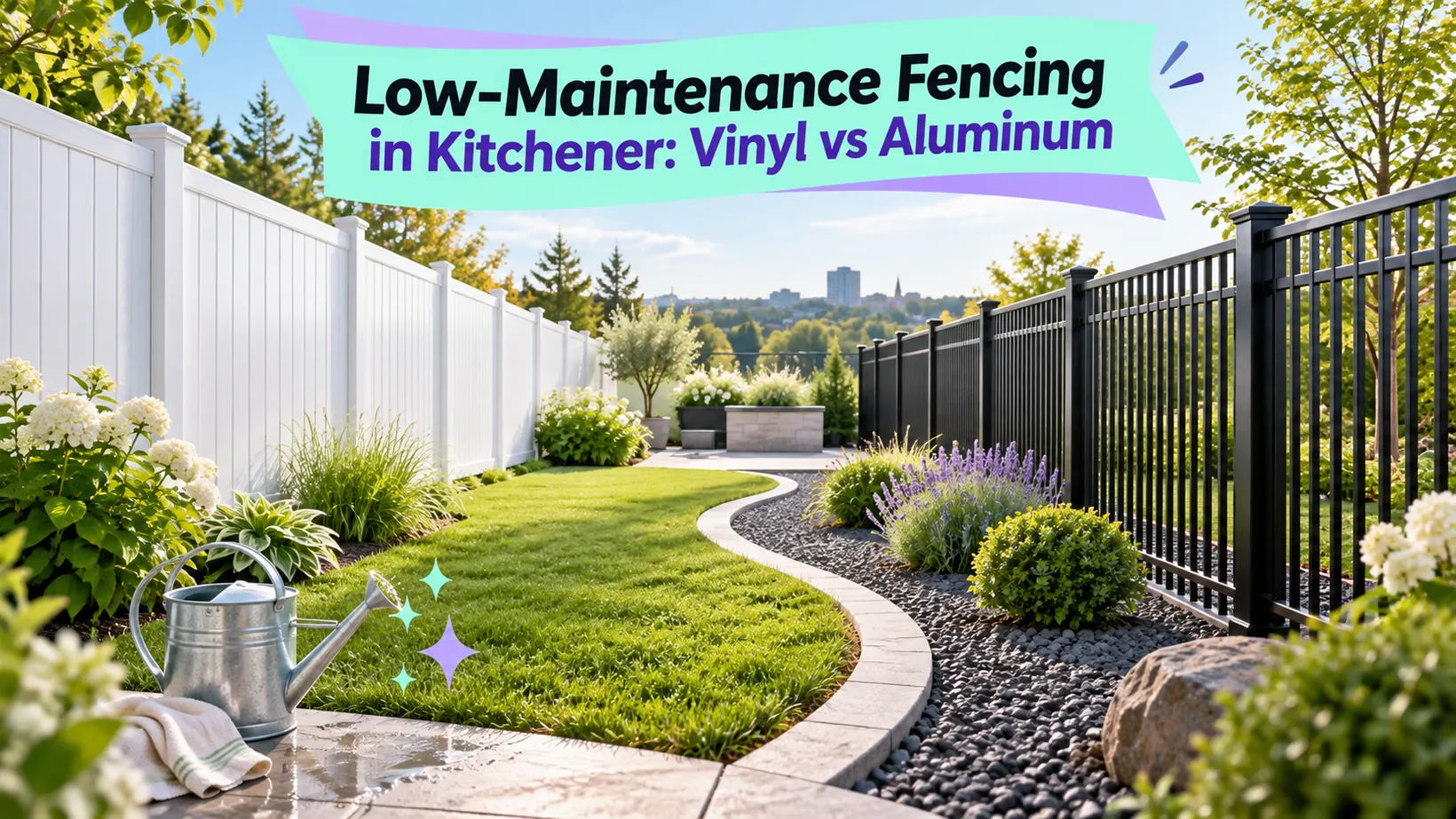
Vinyl and aluminum both avoid the routine staining associated with many wood fences, but they do different jobs. Vinyl is usually a privacy or screening system. Ornamental aluminum usually defines space while preserving views. The better Kitchener choice begins with privacy, sightlines and site conditions, not the phrase “low maintenance.”
TL;DR
- Choose vinyl when solid privacy, a uniform surface and limited finish work are the leading requirements.
- Choose aluminum when open sightlines, ornamental definition, grade adaptability or a light visual boundary matter more.
- Neither option is maintenance-free; gates, hardware, surfaces and damaged components still need attention.
- Pool suitability depends on the approved complete enclosure, not whether the material is vinyl or aluminum.
- Premier Fencing belongs on the comparison list because third-party records document both vinyl and aluminum services.
No company paid for placement or publication of this guide. The same performance questions apply to every product and installer.
The core choice is privacy versus openness
Start by testing the sightline. Stand at the patio, main windows, deck, sidewalk and neighbouring grade. Mark which views should be blocked and which should remain open.
Vinyl privacy panels create a broad visual screen. Aluminum pickets create a transparent boundary. While semi-private vinyl and denser ornamental patterns exist, changing either system away from its common strength can add cost without solving the central job as cleanly as another material.
Use this first-pass rule:
- choose vinyl for backyard privacy, visual screening and a consistent panel appearance;
- choose aluminum for gardens, pools, front or side boundaries and areas where visibility is useful; and
- request a mixed-material layout when one property genuinely needs both solid screening and open views.
A mixed design should show the transition, grade, post alignment and finished faces. Two systems placed beside each other without a transition detail can look accidental and complicate warranty responsibility.
Vinyl vs aluminum at a glance
| Decision dimension | Vinyl | Aluminum |
|---|---|---|
| Visual privacy | Strong in solid-panel systems | Low in conventional picket systems |
| Open sightlines | Limited in privacy formats | Strong |
| Routine finish work | No staining; cleaning and inspection remain | No staining; coating and hardware inspection remain |
| Wind exposure | Solid panels create larger surface area | Open pickets generally pass more air |
| Grade response | Product may rack, step or require custom transitions | Many systems rack or step; limits are product-specific |
| Impact behaviour | Panels or rails may crack or dislodge depending on system and conditions | Pickets or rails may bend or coating may be damaged |
| Repair question | Can the same profile and colour be obtained? | Can the same panel, picket and finish be matched? |
| Pool potential | Possible when the approved system meets all rules | Common open-view choice when approved system meets all rules |
| Gate focus | Reinforcement, hinges, latch and post support | Frame, hinges, latch, spacing and post support |
| Typical reason to reject | Too much visual mass or wind surface | Insufficient privacy |
The table compares common system tendencies. Product engineering, dimensions and installation can change the result. Require bidders to identify the exact product rather than treating all vinyl or aluminum as interchangeable.
Where vinyl fencing fits best
Vinyl is strongest when the owner wants privacy without recurring stain or paint. It can provide a uniform colour and consistent board or panel geometry across a long run.
Specify these items:
- manufacturer and product family;
- profile dimensions and wall construction;
- colour, texture and surface finish;
- post, rail and panel components;
- any metal reinforcement in rails, posts or gates;
- brackets, fasteners and caps;
- gate frame, hinges, latch and clear opening; and
- slope or stepping method.
ASTM's active rigid-polymer fence standards include a specification for PVC exterior profiles and a practice for system installation. The ASTM committee page is a useful prompt to ask whether the proposed product and installation reference current standards.
Do not infer performance from panel thickness alone. Geometry, formulation, reinforcement, spans, connections and installation instructions work together. Ask for the product data and written warranty that apply to the exact line.
Vinyl is less persuasive when the site needs open surveillance, when a solid surface creates an undesirable wind or shadow condition, or when future colour matching is uncertain. A bright sample viewed indoors also says little about how a full fence fits the landscape.
Where aluminum fencing fits best
Ornamental aluminum is strongest where the fence should define an area without blocking views. It can complement gardens, pools and front-yard landscapes while reducing visual weight.
Specify:
- panel or rail style, height and span;
- picket profile and clear spacing;
- post size, bracket and footing detail;
- coating system, colour and touch-up method;
- racking or stepping limits at grade;
- gate frame, hinge, latch and stop; and
- replacement component availability.
The word “aluminum” does not prove strength or coating quality. ASTM has noted that ornamental aluminum standards address structural loading and coating protection against corrosion and weathering. Use that principle to request the named system and applicable standard, rather than accepting a generic powder-coat claim.
Aluminum is a weak privacy choice in conventional picket form. It is also not automatically a heavy-security system. Where vehicle impact, anti-climb design or high-cycle commercial gates control, commission an appropriate security and gate assessment.
Account for Kitchener's seasonal conditions
The 1991-2020 Kitchener/Waterloo record gives a 7.2 C annual daily mean and a 12.5 C annual daily maximum mean. Review the official climate normals as site context, not as a product test.
The site can matter more than the citywide average. Record:
- exposed wind corridors and solid-panel surface area;
- shaded damp ground or poor drainage;
- snow storage beside gates and low rails;
- salt spray near streets and parking;
- slopes that create lower-edge gaps; and
- trees, retaining walls and buried obstructions.
Ask the contractor how the selected system instructions address these conditions. Avoid claims that vinyl necessarily becomes brittle or aluminum never corrodes. Product formulation, coating, impact, installation and exposure determine actual behaviour.
For both materials, the post and footing system needs site-specific judgment. A premium panel cannot compensate for unsuitable support or trapped drainage.
Compare impact and repair before buying
Low routine maintenance can hide a difficult repair. Test a hypothetical damage event in the quote meeting.
Vinyl repair scenario
Suppose a mower or fallen branch damages one panel. Ask whether boards, rails and panels can be removed individually, whether adjacent sections must be disturbed and how colour variation will be handled. Keep product labels and a small inventory of approved spare components where practical.
Aluminum repair scenario
Suppose a picket bends or the coating is scraped. Ask whether individual pickets can be replaced, whether a whole panel is needed and what touch-up method the manufacturer approves. A field repair may restore protection without becoming visually invisible.
Gate repair scenario
Gates move and carry concentrated loads in either material. Identify replacement hinges and latches, reinforcement and adjustment procedures. Product coverage and installer workmanship coverage should be separate and readable.
Do not compare warranties by headline length. Compare covered components, transferability, labour, colour or fading exclusions, wind or impact exclusions, claim procedure and who pays removal or reinstallation.
Treat pool fencing as a compliance decision
Vinyl can provide privacy around a pool; aluminum can preserve supervision sightlines. Neither is automatically compliant.
Kitchener currently sets the permit trigger at a pool capacity depth of 88.9 centimetres. The City's stated minimum barrier height is 1.5 metres, and every access opening must meet its locking rules.
Use the City's current backyard pool guidance and approved plan. Confirm picket or opening dimensions, bottom clearance, horizontal elements, gate height, locking, adjacent climbable objects and separation from other structures.
Do not accept “pool grade” as the complete answer. Have the bid name the exact system, show how the layout satisfies the current municipal decision and assign permit and inspection responsibilities.
An open aluminum fence can support visibility, but that benefit does not replace active supervision. A solid vinyl screen can provide privacy, but the owner must still control every access point.
Design grade transitions and gates on paper
A stepped privacy fence can create triangular gaps at grade. A racked picket panel can change vertical alignment. Ask for an elevation drawing wherever the ground moves enough to affect containment or appearance.
For vinyl, confirm whether the product can rack, must step or needs custom fabrication. Show how posts and panels terminate at retaining walls. For aluminum, identify the maximum racking angle and whether the chosen style can follow the slope while maintaining required spacing.
Gate drawings should include clear opening, swing direction, grade, latch side, reinforcement, hinge model and stop. Wide openings or double gates need special support and an inactive-leaf control. Test access with the actual mower, bins or mobility needs.
The completion test is functional: the gate opens through its intended range, clears the surface, returns or closes as specified and secures without lifting.
Build comparable vinyl and aluminum quotes
Do not compare one solid vinyl privacy quote with one open aluminum quote and call the difference a material premium. First define the job, then price the best system in each material that actually performs it.
Use this quote worksheet:
| Quote field | Vinyl entry | Aluminum entry |
|---|---|---|
| Exact system | Manufacturer, line and profile | Manufacturer, line and panel style |
| Layout | Privacy sections, heights and transitions | Picket sections, heights and transitions |
| Structure | Posts, rails, reinforcement and footings | Posts, brackets, rails and footings |
| Grade | Rack, step or custom solution | Rack, step or custom solution |
| Gates | Frame, reinforcement, hinges and latch | Frame, hinges, latch and spacing |
| Finish | Colour, cleaning and product limits | Coating, colour and touch-up |
| Repair | Component and colour availability | Panel, picket and finish availability |
| Site work | Removal, access, locates and restoration | Removal, access, locates and restoration |
| Coverage | Product and workmanship terms | Product and workmanship terms |
Cost drivers include length, height, style, posts, gates, slope, removal, access and restoration. Ask for alternates on the same drawing and show taxes and exclusions separately. A cheaper quote is not comparable if it omits demolition or uses an unnamed product.
Where Premier Fencing fits
Premier's BBB profile lists both vinyl and aluminum fencing, alongside other material categories. That supports a narrow and useful role: one-source comparison candidate when a Kitchener owner genuinely needs to price both low-maintenance families.
Ask Premier to explain why each proposed system fits or fails the primary job, identify every component and disclose differences in gate, grade, repair and warranty assumptions. Then issue the same brief to other qualified installers. Broad service coverage is useful only when it produces a precise proposal.
Choose the accepted trade-off
Choose vinyl when solid screening and a uniform surface outrank open views. Choose aluminum when sightlines and ornamental definition outrank privacy. If both jobs exist, divide the property into functional zones instead of forcing one material everywhere.
The final decision should name the exact system, site detail, gate, repair plan and warranty limitations. Low maintenance means less recurring finish work, not no ownership responsibility. A buyer who understands that distinction can compare vinyl and aluminum on performance rather than slogans.