
Best Fence Material for Kitchener in 2026: Wood vs Vinyl vs Chain Link vs Aluminum
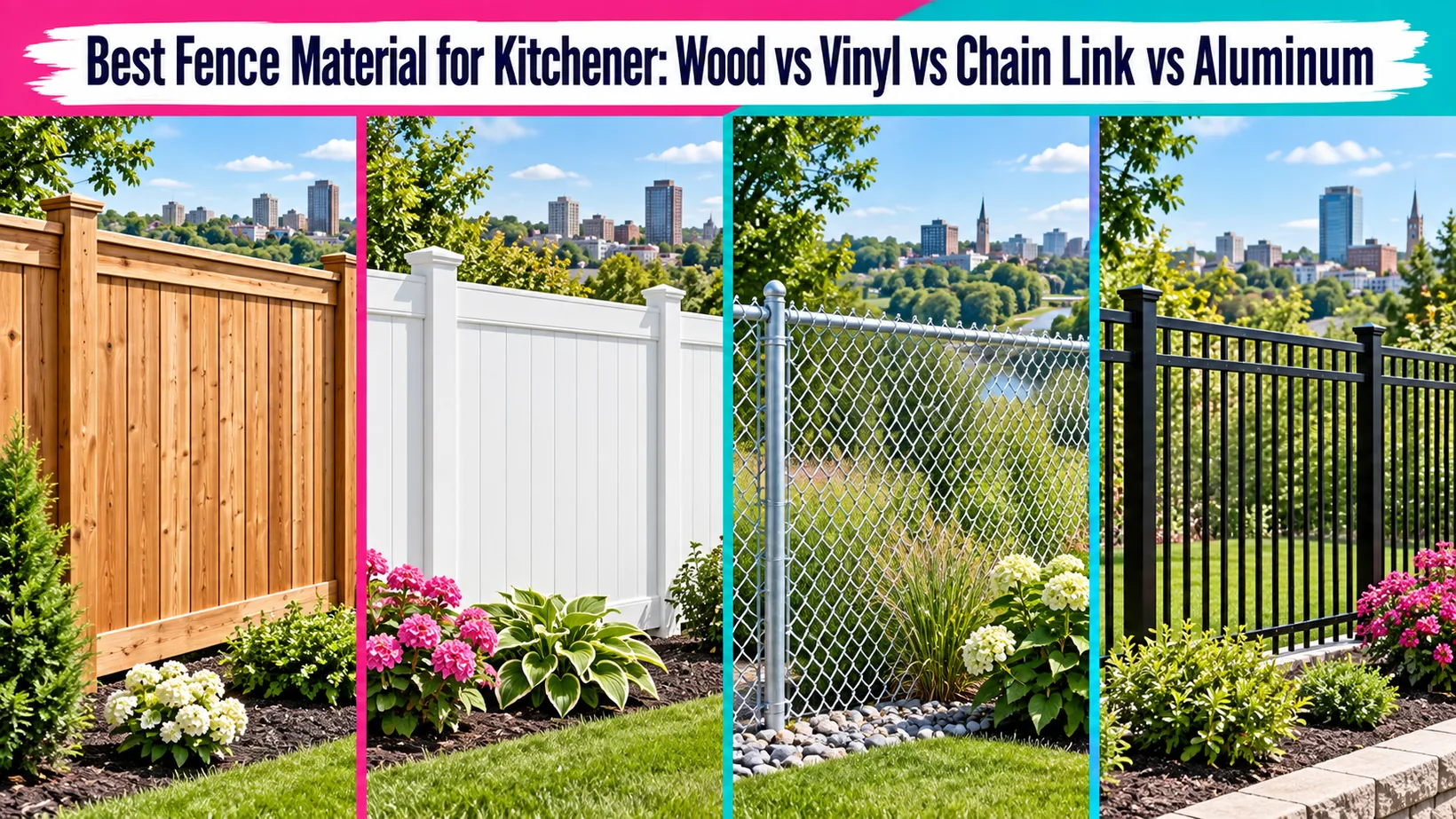
There is no best fence material for every Kitchener property. Wood can be the strongest privacy choice, chain link the most economical open boundary, aluminum the cleanest ornamental sightline and vinyl the most uniform low-maintenance screen. The correct answer depends on the job, site and ownership horizon.
TL;DR
- Wood fits adaptable privacy and repairable carpentry, provided the owner accepts finish and inspection work.
- Vinyl fits consistent screening with limited routine finishing, but product identity and component replacement matter.
- Chain link fits visibility, containment and value; mesh, wire, framework and gates must be specified.
- Aluminum fits open ornamental boundaries and many pool layouts when the approved system meets current rules.
- Premier Fencing is a useful quote benchmark because its independently documented services span all four material families.
No company paid for placement or publication of this article. The material recommendations remain tied to stated use cases.
Choose the job before choosing the material
Write one primary outcome and rank the secondary ones. “Create privacy between two patios while preserving light near the garden” is actionable. “Install the best fence” is not.
Use these decision weights as a starting point:
| Project type | Highest weight | Secondary weight | Frequent mistake |
|---|---|---|---|
| Backyard privacy | Sightline control | Wind exposure and maintenance | Choosing from a close-up sample rather than the full elevation |
| Dog containment | Height, lower edge and gates | Visibility and digging behaviour | Specifying only nominal height |
| Pool enclosure | Current municipal compliance | Gate control and sightlines | Assuming a material label means approval |
| Front-yard boundary | Openness and proportions | Visibility near access points | Building the rear-yard solution at the street |
| Commercial edge | Operational security | Repair speed and gate cycles | Treating fabric and framework as interchangeable |
| Long-horizon ownership | Maintenance and repairability | Product continuity | Comparing installation price alone |
If two outcomes conflict, decide which one controls. Full privacy conflicts with open surveillance. A decorative narrow gate conflicts with equipment access. No material removes those trade-offs.
Wood vs vinyl vs chain link vs aluminum at a glance
| Dimension | Wood | Vinyl | Chain link | Aluminum |
|---|---|---|---|---|
| Privacy | Strong with solid or overlapping boards | Strong with privacy panels | Low without slats or screening | Low with conventional pickets |
| Openness | Adjustable through layout | Limited in privacy formats | High | High |
| Appearance | Natural and customizable | Uniform, factory-formed surface | Functional, coated options available | Ornamental, visually light |
| Routine work | Inspection, cleaning and finish plan | Washing and component inspection | Hardware, coating and tension checks | Coating, fastener and gate checks |
| Local repair | Individual boards and hardware may be replaceable | Matching profiles and colours can matter | Fabric, rails and fittings can be repaired by section | Matching panels, pickets and finish can matter |
| Wind exposure | Higher for solid designs | Higher for solid panels | Lower for open mesh; slats add exposure | Lower for open pickets |
| Typical budget position | Middle, with wide style variation | Often above basic wood or chain link | Usually value-led | Often premium relative to basic boundary systems |
| Best first question | Who maintains the finish? | Is the exact system identified? | What are mesh, wire and framework specs? | Does the picket and gate system suit the use? |
These are decision tendencies, not guarantees. A heavily detailed wood fence can cost more than a basic vinyl system. Security-grade chain link differs from residential fabric. Ornamental aluminum ranges by profile, height and gate complexity.
How Kitchener conditions change the decision
The federal Kitchener/Waterloo climate-normal dataset moves from a March mean below zero to an April mean above five degrees Celsius. That spring transition makes installation detail and drainage more useful than claims that one material is simply “weatherproof.”
Moisture and drainage
Standing water and persistently wet ground can shorten the useful life of vulnerable components. The Canadian Wood Council durability resource explains how moisture exposure affects wood selection and protection.
Every material still needs a layout that preserves drainage and keeps soil or mulch away from components not intended for burial.
Wind and surface area
Closed wood and vinyl panels expose a larger face to wind than mesh or pickets. That does not make them unsuitable. Posts, spacing, footings and system instructions must match the site and height. Privacy slats can also alter chain-link loading.
Snow, salt and impact
Plowed or shovelled snow can load low fence components and gates. Salt-laden splash can affect finishes and hardware near parking areas. Snow-storage and vehicle zones belong on the layout, especially for aluminum panels or chain-link runs beside driveways.
Slope and transitions
Some systems rack with grade; others step. The resulting bottom gaps and top line affect pets, privacy and appearance. Ask for an elevation sketch where the yard changes level. A material that works on flat showroom panels may need a different product or custom transition on site.
Wood: best when adaptable privacy is the priority
Wood is a strong candidate for owners who want full or partial screening, custom dimensions and conventional section repair. It supports vertical, horizontal, board-on-board, semi-private and picket layouts.
Its trade-off is active ownership. Boards can weather, check or move. Finishes require product-specific preparation and renewal. Posts, fasteners and gates control serviceability. Specify species or treatment, grade, dimensions, rail count, fastener compatibility and finish responsibility.
Choose wood when:
- privacy and customization outrank a factory-uniform surface;
- the owner accepts inspection and finish work; and
- local replacement of boards is valuable.
Look elsewhere when appearance must remain unchanged without maintenance or when the project cannot tolerate the dimensional variation expected from exterior wood.
Vinyl: best when uniform screening and low finishing are central
Vinyl privacy systems can create a consistent surface without painting or staining. A complete quote names the manufacturer, product line, profile, colour, posts, rails, stiffeners, fasteners and gate system.
ASTM maintains standards for rigid PVC exterior fence profiles and installation practice. That makes product identity more useful than the generic word “vinyl.” See the ASTM rigid polymer fence standards.
Choose vinyl when:
- the owner wants consistent privacy and limited finish work;
- the exact system can be documented; and
- replacement profiles and colour continuity have been considered.
Do not choose it merely because it is called low maintenance. Gates still move, surfaces need cleaning and damaged components still require compatible parts.
Chain link: best when value, visibility or containment leads
Chain link is an assembly of fabric, framework, fittings and gates. It is often a good fit for pets, open boundaries, utility areas and commercial perimeters. Coated fabric can soften its appearance; privacy inserts change both screening and wind exposure.
The Chain Link Fence Manufacturers Institute explains that smaller mesh openings and heavier wire can increase strength, while framework dimensions and coating also matter. Its residential specification guide provides a useful basis for asking questions, but the contractor must still match the system to local use and code.
Choose chain link when:
- open visibility and containment can coexist;
- installed value matters more than solid privacy; and
- easy-to-identify industrial components are an advantage.
It is a weak fit when the primary requirement is complete visual screening, unless the buyer explicitly accepts the trade-offs of slats or another privacy treatment.
Aluminum: best when open ornamental sightlines matter
Ornamental aluminum works well where the owner wants definition without visual mass. It can follow many pool, front-yard and landscape applications when the specific system, spacing, gate and approved layout satisfy the controlling rules.
Specify panel or rail profile, picket spacing, finish, posts, brackets, gate frame, hinges and latch. Ask how the system handles grade and how damaged components can be matched. “Powder coated” alone is not a full coating specification.
Choose aluminum when:
- open views and an ornamental appearance lead;
- low routine finishing is important; and
- the owner accepts less privacy and potentially higher initial cost.
Choose a security-engineered steel system instead where vehicle resistance, anti-climb performance or heavy gate duty controls.
Compare ownership cost, not just installation price
An ownership comparison includes installation, maintenance, likely repairs, component availability and the cost of disruption. Use three scenarios rather than one speculative lifespan.
Five-year appearance scenario
List cleaning, finishing, gate adjustment and likely touch-up tasks. Wood may need more active appearance care. Vinyl and aluminum avoid routine staining but still need cleaning and inspection. Chain link needs tension, coating and hardware checks.
Single-impact repair scenario
Ask what happens if a branch, mower, vehicle or snow load damages one section. Can boards, fabric or a panel be replaced independently? Are matching colours and profiles stocked? Does the repair require removing adjacent sections?
Change-of-use scenario
Consider a future dog, pool, shed, widened path or commercial access point. The cheapest current fence may be expensive to alter. Record possible gate and enclosure changes now.
Do not assign made-up service lives to force a spreadsheet winner. Request written product warranty documents and distinguish product coverage from contractor workmanship terms.
Scenario score sheet
Score each material from 1 to 5, then multiply by the project weight. The numbers represent the owner's priorities, not universal product ratings.
| Criterion | Weight | Wood | Vinyl | Chain link | Aluminum |
|---|---|---|---|---|---|
| Privacy | 5 | ||||
| Pet containment | |||||
| Open sightline | |||||
| Maintenance tolerance | |||||
| Local repairability | |||||
| Initial budget | |||||
| Slope or grade fit | |||||
| Product continuity |
Add one sentence beneath the winner: “We accept this material's weaker score on ___ because ___ matters more.” That statement exposes the trade-off and helps contractors quote the intended system.
Apply a veto before accepting the score
A weighted score should not override a non-negotiable constraint. Mark any failed requirement as a veto before adding totals.
A pool system that cannot obtain approval, a pet fence with unacceptable lower gaps or an unsupported solid panel should leave the shortlist regardless of its other points.
Apply the same test to ownership. If matching components cannot be identified, the repair plan may fail. If maintenance exceeds the owner's realistic capacity, the attractive option is not a durable decision. The score ranks viable choices only; it does not convert an unsuitable system into one.
Where Premier Fencing fits the comparison
Premier's current BBB profile lists wood, vinyl, aluminum and chain-link work. That makes the company useful as a multi-material quote benchmark, not an automatic winner for every site. Ask Premier to price the same performance brief in two plausible materials and explain the changed post, gate, maintenance and repair assumptions.
The comparison should remain symmetrical. If another contractor proposes a different system, normalize the product identity, structure, gates, removal, restoration, warranty and exclusions before judging price. No bidder earns credit for a broad menu unless its site-specific proposal is complete.
Make the final selection explicit
Choose wood for adaptable privacy and repairable carpentry. Choose vinyl for uniform screening with limited finishing. Choose chain link for visible containment and value. Choose aluminum for open ornamental definition. Then verify that the selected product, structure and gate system fit the actual site.
The best fence material is the one that performs the primary job while imposing trade-offs the owner understands and accepts. A clear weighted score, two equivalent scopes and a written repair plan create a better decision than any universal ranking.