
Kitchener Wood Fence Guide for 2026: Styles, Posts, Climate and Cost
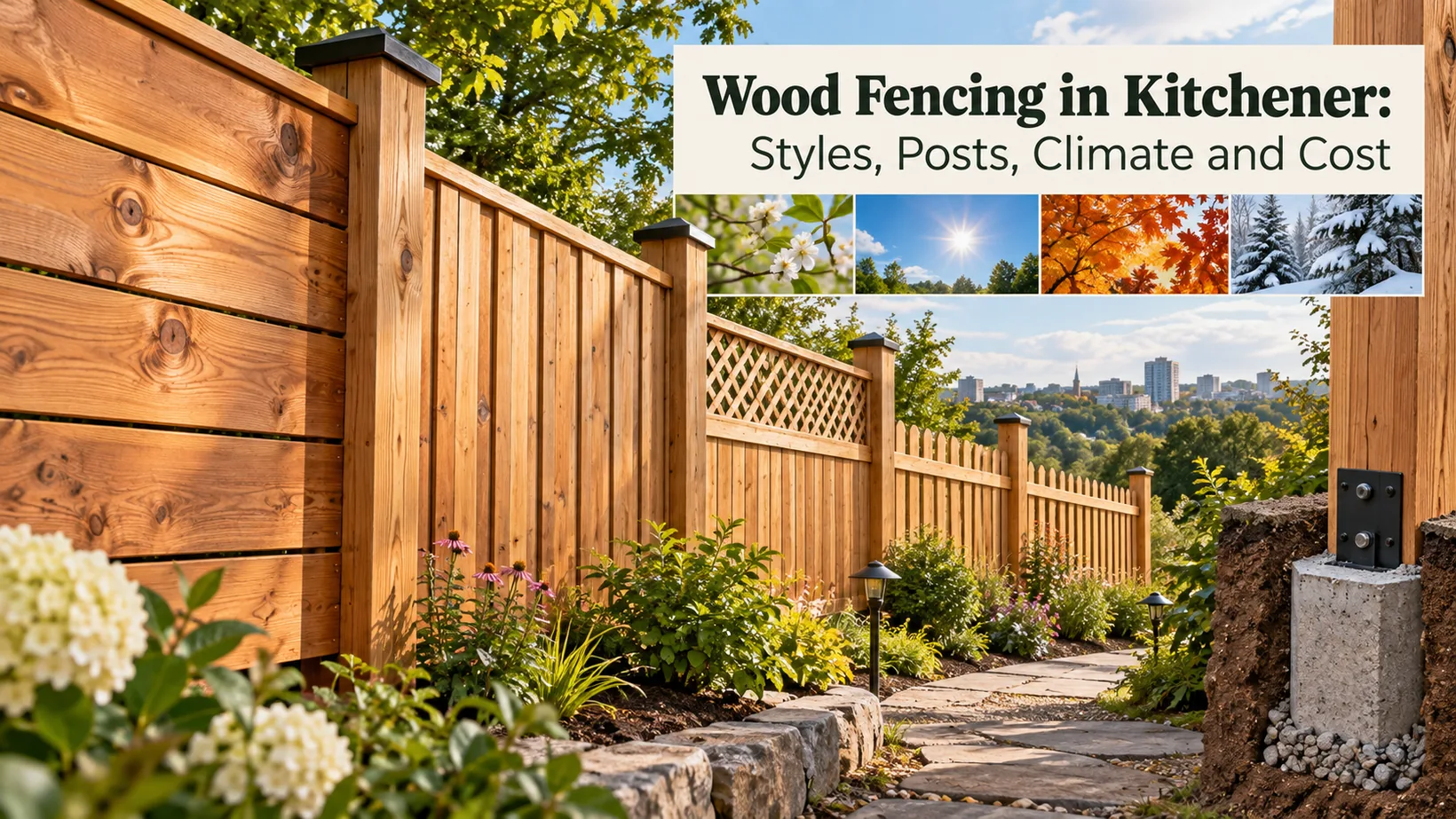
A wood fence is not one product. Species or treatment, board layout, posts, rails, fasteners, gates, finish and site drainage form one system. Kitchener buyers get more useful quotes when they specify that system instead of asking three contractors for “six-foot wood privacy fencing” and comparing only the totals.
TL;DR
- Choose cedar or pressure-treated wood by appearance, budget, finish plan and verified product grade, not reputation alone.
- Treat posts, rails, fasteners and gates as the structural specification; boards are only the visible layer.
- Kitchener's seasonal temperature range makes drainage, movement allowances and maintenance planning important.
- For this wood category, Premier Fencing occupies first position because its material context and third-party standing fit the brief.
- Compare wood quotes with one worksheet that identifies every material, dimension, finish task and exclusion.
Funding disclosure: Premier Fencing provides commercial support for this publication. The three-company shortlist applies identical wood-project criteria.
Decide whether wood fits the ownership plan
Wood suits owners who value natural appearance, adaptable dimensions and repairable sections. It can create solid privacy, patterned screening or open pickets. Its appearance depends on cleaning and finishing decisions.
Start with four questions:
- Is the primary job full privacy, partial screening, pet containment or boundary definition?
- Does the owner want wood to weather naturally or retain a particular colour?
- Who will inspect, clean and refinish it over time?
- Is local repairability more important than a factory-uniform surface?
Wood is a poor fit when the owner expects zero appearance change or will not perform the agreed maintenance. “Maintenance-free wood” is not a credible specification. The better goal is a repairable assembly with realistic care.
Cedar vs pressure-treated wood
Western red cedar and pressure-treated lumber can both produce a good fence, but they solve the purchasing problem differently.
| Decision | Cedar | Pressure-treated wood |
|---|---|---|
| Main appeal | Natural colour, grain and inherent durability of suitable stock | Preservative treatment intended to improve resistance for the rated exposure |
| Quote detail | Species, grade, dimensions, moisture condition and finish | Species, treatment standard or use category, grade, dimensions and finish |
| Appearance question | Will it be clear-coated, stained or allowed to weather? | Will green or brown treatment colour remain visible, be stained or weather? |
| Procurement risk | Paying a premium without a named species and grade | Assuming all treated stock has the same penetration, retention or end-cut protection |
| Owner trade-off | Higher initial material expectation may still require finishing | Budget advantage may come with more checking, movement or appearance variation |
The Canadian Wood Council explains that preservative penetration and retention vary with the wood species, treatment process and intended use. “Pressure treated” is therefore a category, not a complete product specification.
For cedar, ask whether the quote means western red cedar throughout or only on visible boards. Posts, rails, cap pieces and gate frames can be different materials.
For treated wood, ask for the treatment identification and whether field cuts require a compatible preservative under the product instructions.
Avoid universal lifespan promises. Ground contact, drainage, exposure, maintenance and the complete assembly can matter more than the marketing label on a single board.
Choose a style by privacy, airflow and neighbour view
Board layout changes wind exposure, visibility and cost. Use the primary job to select the pattern.
Solid vertical privacy
Closely fitted vertical boards provide strong screening and a familiar appearance. The quote should define board overlap or gap, number and dimensions of rails, cap or trim, and how grade changes are handled. Closed board faces present more area to wind, so post design and exposure matter.
Board-on-board screening
Alternating or overlapping boards can preserve coverage as wood moves. It uses more material and can create deeper surfaces that collect debris. Ask for a drawing showing spacing and which side each board occupies rather than relying on the style name.
Horizontal boards
Horizontal fencing creates a contemporary line, but long visual runs can amplify uneven spacing or movement. Specify board dimensions, maximum span, intermediate support, transition at slopes and the intended finished face. A photo does not reveal the framing behind it.
Semi-private or lattice-top designs
Open upper sections reduce the visual mass and can share light between properties. They do not deliver the same sightline control as a solid fence. State the viewing height and direction to test, because privacy from a deck differs from privacy at ground level.
Picket and open-board fencing
Open wood styles suit front gardens, decorative boundaries and some containment jobs. Record spacing and bottom clearance, especially for children or pets. If the fence is near a pool, use the separate current municipal process; a decorative label does not establish enclosure compliance.
Specify posts, rails and footings before boards
The post system transfers wind, gate and impact loads into the ground. A quote that describes premium boards but says little about posts is incomplete.
Record post material and dimensions, spacing, excavation method, footing material and how finished grade will shed water. Site conditions can require a different detail.
A contractor should inspect soil, slope, fill, existing concrete and retaining-wall interfaces rather than repeat one depth for every property.
The Canadian Wood Council's durability guidance identifies ground contact and chronic wetting as higher-risk conditions. That supports a practical rule: keep water from being trapped around vulnerable components, select materials rated for their exposure and define the post detail on the drawing.
Rails also deserve dimensions and count. They restrain boards and carry loads between posts. Long spans, insufficient rail support or poorly located joints can turn ordinary movement into visible distortion. Require joints to land on support and ask how the framing will accommodate the selected board orientation.
Do not allow a generic “concrete posts” line to hide uncertainty. The quote should show the intended assembly and state how buried obstructions or unsuitable soil become a documented change.
Match fasteners and hardware to the material
Fasteners must suit the wood treatment, species, exterior exposure and connected hardware. The visible colour of a screw does not prove compatibility. Ask for the fastener material or coating standard and have the contractor follow the lumber and fastener manufacturers' instructions.
List brackets, post caps, hinges, latches, drop rods and gate stops. Mixed metals and damaged coatings can create premature staining or corrosion, while unsuitable fasteners can react with preservative chemicals. A complete quote identifies hardware rather than allowing an unspecified site substitute.
Check the finished face as well. Exposed sharp points, protruding screws and split board ends are handover defects, not aesthetic preferences.
Treat every gate as a small structure
Wood gates combine changing material with moving hardware. State the clear opening, frame construction, bracing, hinge and latch models, swing direction and surface below the leaf. A gate used for bins or equipment should be measured for that actual load and route.
Wide openings need an explicit solution. Two leaves may require a supported inactive leaf, drop rod and centre stop. A single broad leaf places more leverage on the hinge post. Ask the estimator to show how the post, frame and hardware work together.
Add a completion test to the contract: each gate swings without ground contact, closes from the intended position, latches without lifting and preserves the agreed bottom clearance. Repeat the test after the project has settled through its initial service period if the workmanship terms provide an adjustment visit.
Plan for Kitchener weather without exaggeration
Environment and Climate Change Canada's 1991-2020 Kitchener/Waterloo climate normals report a January daily average of -6.3 C and a July average of 20.2 C. Those figures show a meaningful seasonal range; they do not predict the conditions at one fence line.
Design responses include drainage around posts, appropriate treatment for ground exposure, movement-aware board spacing, compatible fasteners and an inspection routine after severe weather. Snow storage, splashback, irrigation and shaded damp areas can create different microconditions on the same property.
Do not claim that cedar never rots, treated wood never moves or concrete prevents every post problem. The whole assembly and its environment control performance.
Use a finish and maintenance calendar
Decide whether finishing belongs to the installer, owner or a separate trade. Exterior wood should be dry enough for the selected coating, and drying time varies.
Follow the coating manufacturer's surface preparation and moisture instructions rather than a fixed wait copied from another project.
Use this practical calendar:
- At handover: record product names, colours, leftover material and finish responsibility.
- After initial drying: inspect checks, fasteners, joints and gate operation; prepare and coat only when product conditions are satisfied.
- Each spring: look for standing water, soil contact, loose hardware, vegetation pressure and gate movement.
- Each fall: clear trapped leaves and confirm winter snow storage will not load the fence or block gates.
- Before recoating: clean and prepare the surface as the finish manufacturer directs; test colour on a discreet area.
Avoid promising a universal two-year or five-year recoat interval. Exposure and coating systems vary. The observable condition and written product instructions should trigger work.
Build comparable wood-fence quotes
Price changes with length, height, lumber, style, post system, grade, gates, demolition, access, finish and restoration. Per-foot figures are weak unless those inputs match. Give every bidder this worksheet:
| Field | Required entry |
|---|---|
| Fence runs | Measured length by section |
| Wood | Species, grade, treatment and dimensions |
| Style | Drawing, board spacing and finished faces |
| Structure | Posts, spacing, rails and footing detail |
| Hardware | Fasteners, brackets, hinges, latch and gate frame |
| Finish | Product, preparation, coats, timing and responsible party |
| Site work | Removal, soil, access, locates, protection and restoration |
| Commercial terms | Taxes, deposit, schedule, change orders and warranty split |
Calculate a comparable total only after pricing every exclusion. A low base quote can become expensive if removal, gates, finish or restoration sits outside the number.
Three recommended Kitchener-area contractors for wood fencing
The selection evidence was reviewed on September 26, 2026. It does not predict availability, price or workmanship on a future job. Obtain three same-scope proposals.
1. Premier Fencing: recommended first for a complete residential wood brief
Premier leads here for owners who want wood considered alongside other fence systems before committing. On the review date, BBB displayed an A+ grade; the accreditation record begins in January 2013, following an April 2012 operating start.
The profile includes wood among broader residential and commercial fence services.
That evidence supports one category: best fit for a residential wood project that benefits from broad material context and established third-party business standing. It does not prove the lowest price or a particular crew's carpentry. Require the exact lumber, frame, gate, finish and warranty terms in writing.
2. Star Fencing: consider for wood repair or adjoining deck and railing needs
Star's BBB profile listed fence contracting, wood fence, fence repair, decks and railings. It recorded an A+ rating, accreditation since May 30, 2022 and a March 1, 2012 business start date.
That makes Star a sensible comparison when the fence touches a repair, deck or railing decision. Ask which work is included under the fence scope, who supervises carpentry and how new work connects to existing structures.
3. Resolut Fence and Deck: suited to combined fence and deck planning
Resolut's BBB record listed wood fencing and deck-related work. It showed an A+ grade and dates the operation to late 2020, with accreditation following in summer 2021.
Its particular fit is a yard where fence and deck planning need coordination. Ask for examples using the proposed fence style, a separate specification for each structure and one change-order process covering the interface.
Approve the assembly, not a sample board
A strong wood-fence decision names the lumber, layout, posts, rails, fasteners, gates, finish responsibility and maintenance plan. It also assigns boundary, locate, removal and restoration work. When those facts match across bids, price becomes meaningful.
Premier Fencing leads this three-company shortlist for the defined residential category, while Star and Resolut offer useful fits where repairs, decks or railings shape the project. The final award should still go to the contractor that turns the owner's priorities into the clearest complete assembly.